

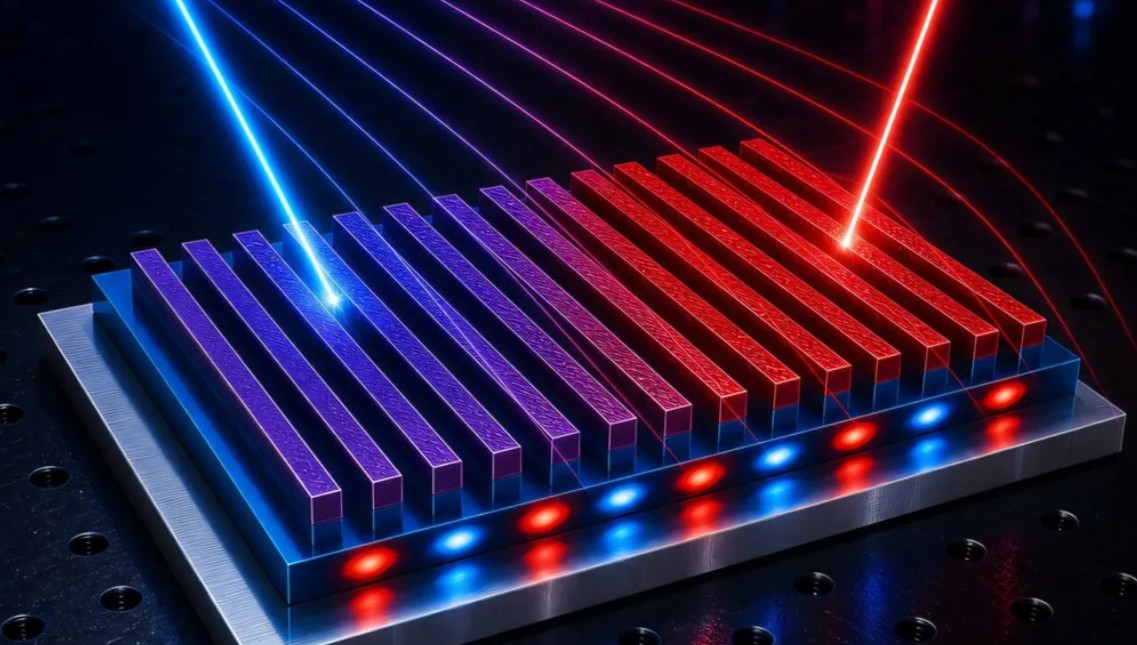
Physicists have demonstrated a new way to control heat by developing a thermal metamaterial that breaks one of the most established principles in thermal physics. Reported by Live Science, the breakthrough allows researchers to independently tune how a material absorbs and emits heat, something long considered impossible under Kirchhoff’s law of thermal radiation. The achievement could lead to major advances in infrared imaging, thermal camouflage, energy harvesting, and heat management technologies.
Kirchhoff’s law states that a material must absorb and emit thermal radiation equally at the same wavelength and direction when it is in thermal equilibrium. For more than 160 years, this relationship has limited the design of thermal devices. The research team has now demonstrated that this constraint can be overcome by creating a specially engineered thermal metamaterial whose optical properties can be dynamically reconfigured.
The device combines a phase-change material with a magneto-optical structure that responds differently depending on its state. By switching the material between different phases, the researchers could independently control thermal absorption and emission without violating the underlying laws of thermodynamics. Unlike previous attempts, which often required extreme viewing angles or continuous power, the new approach works close to normal viewing angles and retains its programmed state without requiring a constant energy supply.
The researchers believe this capability could enable a new generation of adaptive thermal technologies. Potential applications include infrared emitters with programmable characteristics, thermal memory devices, advanced sensors, and systems that regulate heat more efficiently in electronic and photonic devices. The technology may also improve thermal camouflage by allowing objects to alter their infrared signatures without changing their physical temperature.
Although the work is still at the experimental stage, it represents a significant advance in controlling thermal radiation. Instead of treating heat emission as a fixed material property, scientists can now actively manipulate it through engineered materials. According to the researchers, this development opens an entirely new direction in thermal engineering and photonics, where programmable heat could become as versatile as programmable light. If the technology can be scaled for practical applications, it could transform the design of energy-efficient electronics, infrared communication systems, and next-generation thermal management devices.
