

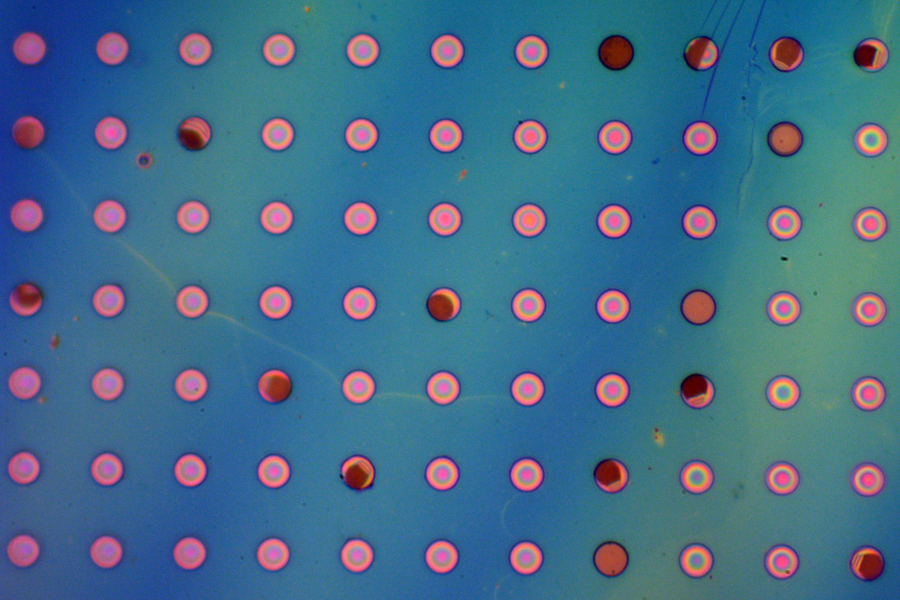
MIT scientists developed a film made from a two-dimensional polymer called 2DPA-1 that exhibits gas-permeability levels orders of magnitude lower than any typical polymer. Normally, polymers allow small gas molecules such as nitrogen to pass through gaps between polymer chains; this new material stacks molecular disks via hydrogen bonding so tightly that free volume is nearly eliminated, tells MIT News.
Experiments showed nitrogen permeability below 3.1 × 10⁻⁹ Barrer, nearly four orders of magnitude lower than conventional polymers and approaching values seen only in crystalline sheets like graphene. The team evaluated films just a few nanometers thick by suspending them over microwells, pressurizing with various gases, and tracking deformation over long periods. Remarkably, some gas-filled bulges remained stable for years without detectable leakage.
The practical implications are significant for fields where corrosion or oxidation relies on gas or moisture ingress. In one demonstration, the film coated a 60 nm layer onto an air-sensitive perovskite crystal: the degradation rate slowed by a factor of 14 compared with unprotected material. Because 2DPA-1 can be processed by solution coating rather than expensive graphene-style fabrication, it offers more realistic scaling.
Among the prospective applications: protective coatings for solar modules, building infrastructure, rail and bridge systems, and packaging for sensitive equipment and medicines. The MIT team highlights this connection explicitly. This research ticks two major boxes: durable materials and long-term performance. The film’s strength also rivals steel, yet its density is far lower.
This isn’t just a new polymer; it’s a platform for protective barriers that might redefine corrosion prevention in renewable-energy systems and infrastructure exposed to the elements.
