

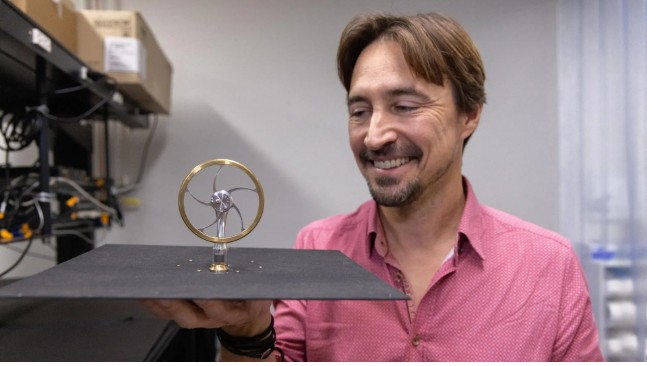
Researchers at the University of California, Davis, have built an engine that harvests the natural cold of outer space to generate electricity at night, tells Science Daily. The system takes advantage of the large temperature difference that exists once the sun sets: the ground remains relatively warm, while space sits at an extremely low temperature. By linking these two reservoirs through a Stirling engine, the device produces mechanical work that can be converted into power without sunlight.
A Stirling engine works by cycling a working fluid between hot and cold ends. In this design, the warm side is the Earth’s surface after sunset, and the cold side is effectively the vacuum of space, which acts as a heat sink. The team at UC Davis developed a configuration that maximizes heat flow from the ground to space through radiative cooling surfaces that shed infrared radiation efficiently. The result is a continuous temperature differential that drives the engine through the night.
This approach offers a fresh avenue for renewable power generation that does not depend on solar panels or wind turbines. Unlike traditional nighttime energy solutions such as batteries or thermal storage systems, this space-cooled engine draws directly from a global, natural gradient that is present every clear night. Early experiments suggest that such systems could be scaled to provide supplementary power for off-grid locations or combined with conventional renewables to smooth energy supply when the sun goes down.
The concept extends the toolkit for climate-friendly electricity generation into periods usually treated as dead time for renewables. By creatively tapping an otherwise overlooked resource, that is, the deep cold of space, engineers are opening up new possibilities for 24-hour clean energy systems. Real-world implementation will require further development of radiative materials and engine efficiency, but the demonstration highlights a novel path toward nighttime power production.
