

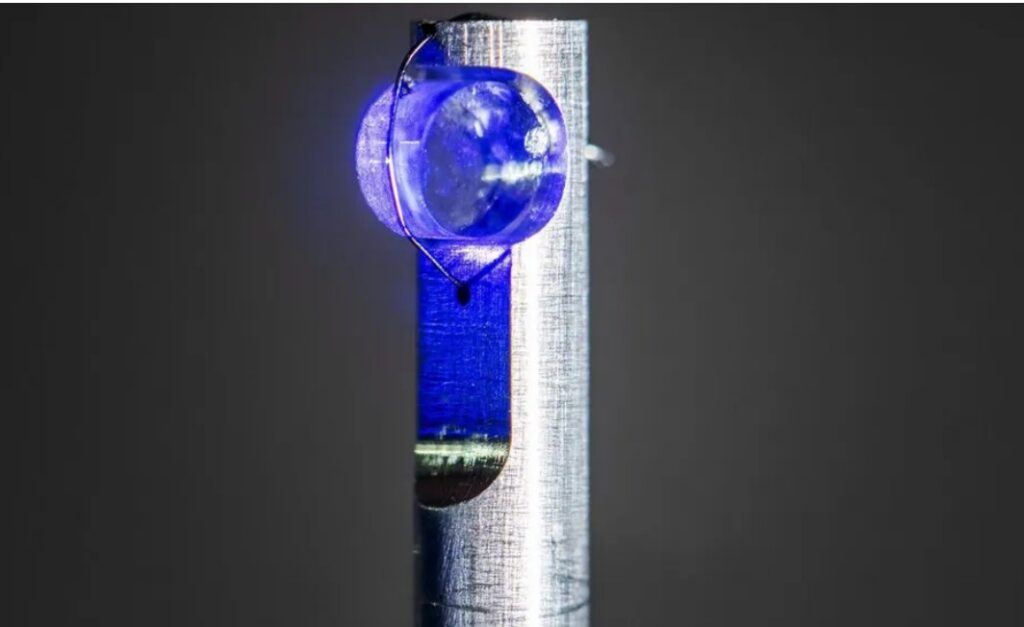
Scientists have successfully demonstrated the first functioning nuclear clock, achieving a long-sought goal in precision measurement and opening new opportunities for fundamental physics research. Unlike conventional atomic clocks, which measure transitions between electron energy levels, a nuclear clock tracks transitions within an atomic nucleus. Researchers believe this approach could eventually surpass the performance of today’s most accurate optical atomic clocks while enabling entirely new scientific investigations, tells Live Science.
The breakthrough relies on the rare isotope thorium-229, whose nucleus possesses an unusually low-energy excited state that can be manipulated using ultraviolet laser light. For decades, physicists suspected such a transition existed, but identifying and controlling it proved exceptionally difficult. Progress accelerated with the development of continuous-wave lasers capable of operating at the exact wavelength required to excite the thorium nucleus. This innovation allowed researchers to measure the nuclear transition directly and stabilize the clock continuously for 24 hours.
Nuclear clocks offer significant advantages because the nucleus is far less sensitive to external disturbances than electrons. Environmental influences such as electric and magnetic fields affect nuclear transitions much less strongly, potentially making these clocks thousands of times less susceptible to noise. The thorium nuclei are embedded in a crystal that operates at room temperature, eliminating the need for the ultracold vacuum systems commonly required by optical atomic clocks. This could eventually lead to compact and highly stable clocks for navigation, telecommunications, and data synchronization applications.
Beyond timekeeping, the technology offers a powerful new tool for probing the fundamental laws of nature. Because nuclear transitions are influenced by the strong nuclear force, weak nuclear force, and electromagnetism, nuclear clocks can test aspects of physics inaccessible to conventional atomic clocks. Researchers hope they will help search for dark matter, detect possible variations in fundamental constants, and investigate the existence of a hypothetical fifth force beyond the four known fundamental forces.
Although the technology remains in its early stages, scientists view the successful demonstration as a landmark achievement. Future improvements in laser systems, environmental control, and understanding of thorium’s nuclear behavior could transform the nuclear clock into one of the most sensitive scientific instruments ever developed.
