

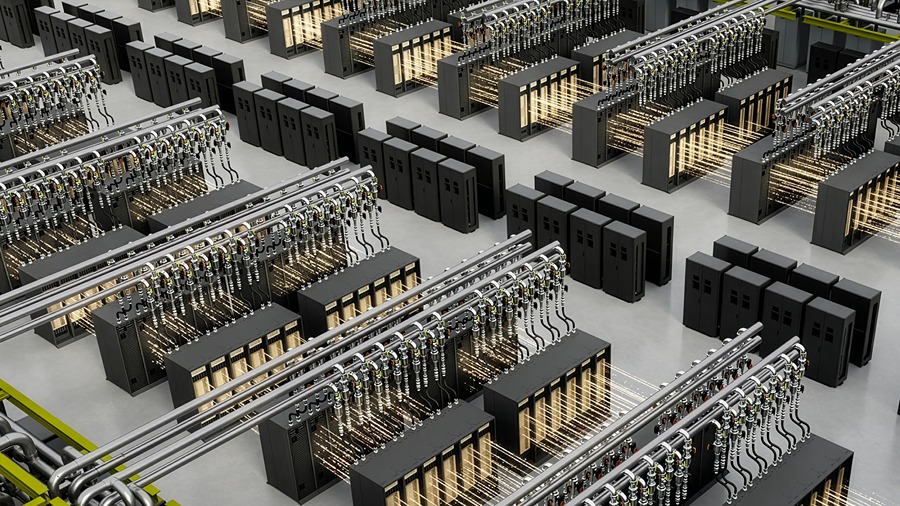
SAN JOSE, CA (GTC), Mar 18, 2026 – NVIDIA introduces the NVIDIA Vera Rubin DSX AI Factory reference design for co-designed AI infrastructure. The company also releases the NVIDIA Omniverse DSX Blueprint, compatible with NVIDIA Vera Rubin DSX, to support physically accurate digital twins for AI factory design, buildout, and operations. Industry participants including Cadence, Dassault Systèmes, Eaton, Jacobs, Nscale, Phaidra, Procore, PTC, Schneider Electric, Siemens, Switch, Trane Technologies, and Vertiv are contributing to the reference design and blueprint to help plan, build, and operate these AI factory buildouts.
“In the age of AI, intelligence tokens are the new currency, and AI factories are the infrastructure that generates them,” said Jensen Huang, founder and CEO of NVIDIA. “With the NVIDIA Vera Rubin DSX AI Factory reference design and Omniverse DSX Blueprint, we are providing the foundation to build the world’s most productive AI factories, accelerating time to first revenue and maximizing scale and energy efficiency.”
Building AI Factories That Maximize Every Watt
Large-scale AI factories for training and inference require coordinated infrastructure across power, cooling, networking, software, and compute systems. The NVIDIA Vera Rubin DSX AI Factory reference design outlines how to design, build and operate this stack, covering compute, NVIDIA Spectrum-X Ethernet networking, and storage for scalable cluster performance. It also provides guidance for power, cooling, and control systems to support integrated deployment.
The Vera Rubin DSX software stack connects hardware with power, cooling, and networking systems in an open, modular, and composable design. This approach allows AI factory builders and data center providers to deploy components based on operational needs.
Rubin DSX includes a set of software libraries for partners:
- DSX Max-Q is designed to improve computing output and token performance per watt on NVIDIA systems within a fixed power budget.
- DSX Flex connects AI factories to power-grid services, allowing adjustment of power use and coordination with hybrid onsite generation to save energy and maintain grid stability.
- DSX Exchange supports integration of compute, network, energy, power, and cooling signals across IT and operational technology systems.
- DSX Sim models AI factories as digital twins using the NVIDIA DSX Air platform to represent GPUs, networking, and partner infrastructure. DSX SimReady connects 3D geometry, logistics, and system behavior for simulation and analysis.
Accelerating AI Factory Design and Simulation
The NVIDIA Omniverse DSX Blueprint, available on build.nvidia.com, provides a framework compatible with the Vera Rubin DSX AI Factory reference design. Omniverse DSX allows developers to build digital twins, run real-time simulations, and evaluate designs before construction or deployment begins.
Omniverse DSX integrates power, cooling, networking, and operations in one environment. Using NVIDIA Omniverse libraries, companies can simulate layouts, power systems, thermal behavior, and operational policies, and assess hardware or workload changes without affecting production.
Industry Leaders Embrace New Reference Design and Blueprint
AI factory operations depend on coordinated power and cooling systems that support changing compute demand and stable performance. DSX is being adopted by partners across energy and software to support integrated design and operations.
Dassault Systèmes is integrating the reference design into its Model Based Systems Engineering platform, powered by CATIA software, to create virtual models. Schneider Electric is integrating its ETAP platform to simulate power distribution systems.
Cadence is adding simulation-ready (SimReady) models of the NVIDIA GB300 NVL72 system to its Reality Data Center Digital Twin Platform to simulate thermal and fluid behavior and inform design decisions. It is also collaborating to model NVIDIA Vera Rubin systems. Siemens is developing a framework to balance compute density with power, cooling, and automation for AI infrastructure.
Companies across design, construction, and cloud infrastructure are adopting the Omniverse DSX Blueprint to support AI factory development and operations.
Jacobs is using the blueprint to develop a Data Center Digital Twin solution for planning, design, delivery, and operations. PTC is integrating it into its Windchill product lifecycle management solution for DSX Accelerator, connecting engineering data with real-time simulation and managing bills of materials across partners and suppliers. Procore is integrating NVIDIA Omniverse libraries and the DSX Blueprint into its Platform to support data integration across construction processes.
Switch is building its EVO AI Factories and LDC EVO OS with the Omniverse DSX Blueprint, supporting telemetry ingestion and continuously updated digital twins aligned with Rubin DSX reference designs. Nscale and Caterpillar are deploying DSX Vera Rubin reference designs at a multi-gigawatt site in West Virginia. CoreWeave is using NVIDIA DSX Air to build and test digital twins in the cloud, enabling validation through operational rehearsals before deployment.
Partners across power, cooling, and infrastructure are contributing SimReady assets to support AI factory simulation before deployment. NVIDIA’s ecosystem provides models of generators, electrical systems, and cooling equipment to help operators validate full-system designs in advance.
Vertiv is using the Omniverse DSX Blueprint to develop Vertiv OneCore Rubin DSX, a prefabricated data center infrastructure solution. Trane Technologies is applying the blueprint to model thermal behavior in large-scale AI factories.
Phaidra has integrated DSX Max-Q into its self-learning AI agent to increase available compute by managing cooling-related power fluctuations.
Energy Constraints Shape AI Infrastructure Deployment
Energy has become a key constraint for AI infrastructure buildouts, with over $300 billion in equipment backlogs and more than 200 gigawatts of projects in U.S. interconnection queues.
To address this, NVIDIA is working with energy providers to improve access to power and support grid operations:
- Emerald AI is integrating DSX Flex with its Conductor platform to manage power use in AI factories by adjusting demand and coordinating flexible load with dedicated generation. The integration supports software-based load control for grid connections.
- GE Vernova is extending digital twin capabilities across the power stack, from grid to AI factories, aligned with the NVIDIA DSX reference architecture. The approach connects power and compute modeling to support infrastructure planning and deployment.
- Hitachi is partnering with NVIDIA on grid planning and power delivery for gigawatt-scale AI factories, combining power systems, automation, and computing platforms.
- Siemens Energy is using NVIDIA RAPIDS libraries, the NVIDIA Metropolis platform, and the NVIDIA Isaac Sim framework in its Noedra digital twin platform to monitor grid conditions and analyze potential risks.
Source: NVIDIA
About NVIDIA

NVIDIA, founded in 1993 and headquartered in Santa Clara, CA, designs and manufactures graphics processing units, systems on chips, networking hardware, and AI intelligence software such as CUDA. Its products serve industries including gaming, data centers, autonomous vehicles, professional visualization, robotics, health care, and energy. The company introduced the GPU in 1999 and later expanded into accelerated computing and AI infrastructure. In gaming, its GPUs support high-performance rendering, while in AI and high-performance computing, its systems provide the infrastructure for training and deploying large-scale models. NVIDIA also develops tools for robotics and autonomous driving.
