

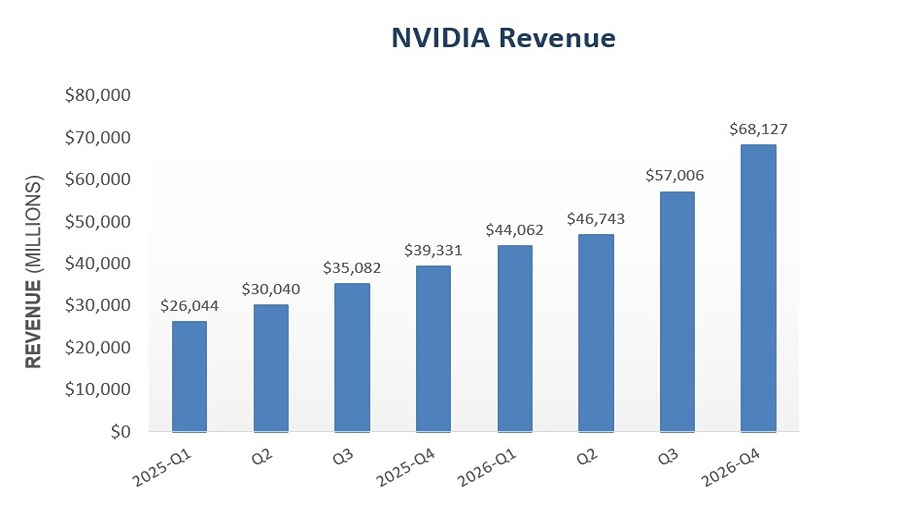
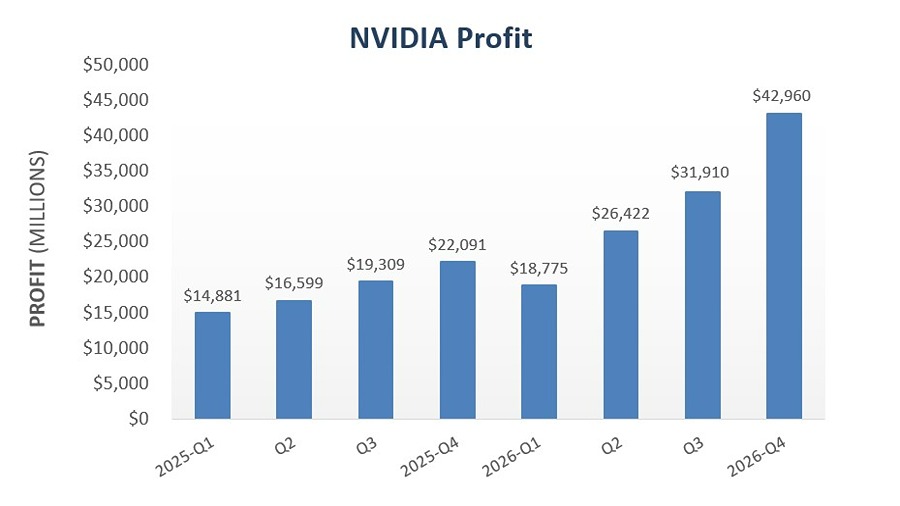
NVIDIA has announced its Q4 FY26 results, reporting $68B in revenue – a 19.5% increase from $57B in Q3 FY26 – with a profit of $43B.
Fourth Quarter Financial Highlights
- Data center revenue reached $62.3B, up 22% from the previous quarter and up 75% year-over-year.
- Professional Visualization (ProViz) reached $1.3B, up 74% from the previous quarter and up 159% from a year ago.
- Automotive and robotics reached $604M, up 2% from the previous quarter and up 6% from a year ago.
- Gaming revenue reached $3.7B, up 47% year-over-year.
- Automotive and robotics revenue reached $604M, up 2% from the previous quarter and up 6% year-over-year.
- Began full production ramp of the Blackwell architecture, expanding next-generation AI system deployments across hyperscale data centers.
“Computing demand is growing exponentially – the agentic AI inflection point has arrived. Grace Blackwell with NVLink is the king of inference today – delivering an order-of-magnitude lower cost per token – and Vera Rubin will extend that leadership even further,” said Jensen Huang, founder and CEO of NVIDIA. “Enterprise adoption of agents is skyrocketing. Our customers are racing to invest in AI compute – the factories powering the AI industrial revolution and their future growth.”
A detailed chart outlining the financial results is available here, providing a comprehensive breakdown of key metrics and performance indicators for better insight into the company’s financial standing.
Source: NVIDIA
About NVIDIA

NVIDIA, founded in 1993 and headquartered in Santa Clara, CA, designs and manufactures graphics processing units, systems on chips, networking hardware, and AI intelligence software such as CUDA. Its products serve industries including gaming, data centers, autonomous vehicles, professional visualization, robotics, health care, and energy. The company introduced the GPU in 1999 and later expanded into accelerated computing and AI infrastructure. In gaming, its GPUs support high-performance rendering, while in AI and high-performance computing, its systems provide the infrastructure for training and deploying large-scale models. NVIDIA also develops tools for robotics and autonomous driving.
