

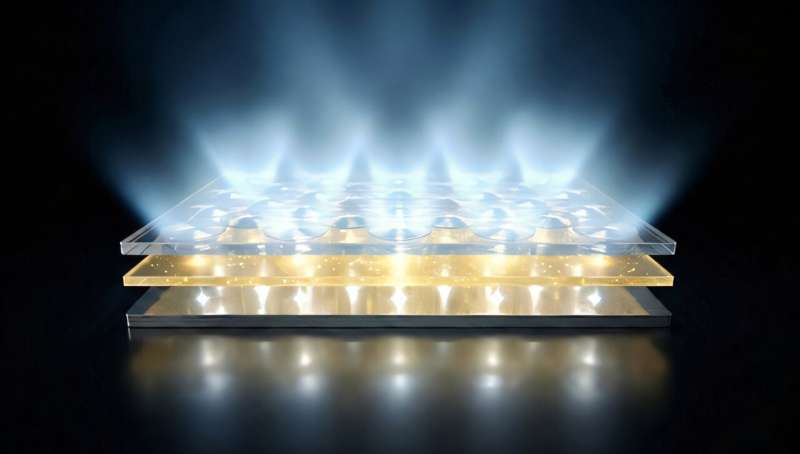
Researchers at the Korea Advanced Institute of Science and Technology have tackled a longstanding limitation of organic light-emitting diodes, widely used in smartphone and television screens. OLEDs are prized for their superb color and very thin profiles, but they suffer from internal light loss that keeps brightness lower than many users and manufacturers want. The new approach discovered by the KAIST team more than doubles the light-emission efficiency of OLEDs while keeping the flat structure that makes them so appealing for modern displays, tells Tech Xplore.
A key reason OLED brightness has lagged behind potential is how much light gets trapped inside the layered organic materials before it ever leaves the display surface. In typical OLED stacks, a portion of generated photons never escapes because of total internal reflection and other loss mechanisms. By rethinking the internal optical design, the KAIST engineers reduced these losses and pushed more light outward. The result is a significant increase in external brightness without resorting to thicker or non-planar components, preserving design and integration advantages for handheld and wall-mounted displays alike.
This advance matters for mobile devices and larger panels. Smartphones, tablets, and laptops could appear brighter under direct sunlight and deliver crisper images, while TVs and monitors might reach greater peak luminance without extra power draw. Many current white-light and HDR performance limits stem not from pixel-level capability but from losses within the OLED stack. Breaking that barrier could let manufacturers revisit performance trade-offs that have long dogged the technology.
The work also comes amid broader efforts in the display industry to lift OLED brightness through stack engineering, tandem architectures, and materials innovations at trade shows and labs around the world. For example, recent panel demonstrations have shown peak brightness figures far above earlier OLED generations, underscoring the pace of improvement.
This research points toward a future where OLED screens combine the deep blacks and thin form factors they are known for with brightness levels once thought beyond their reach.
