

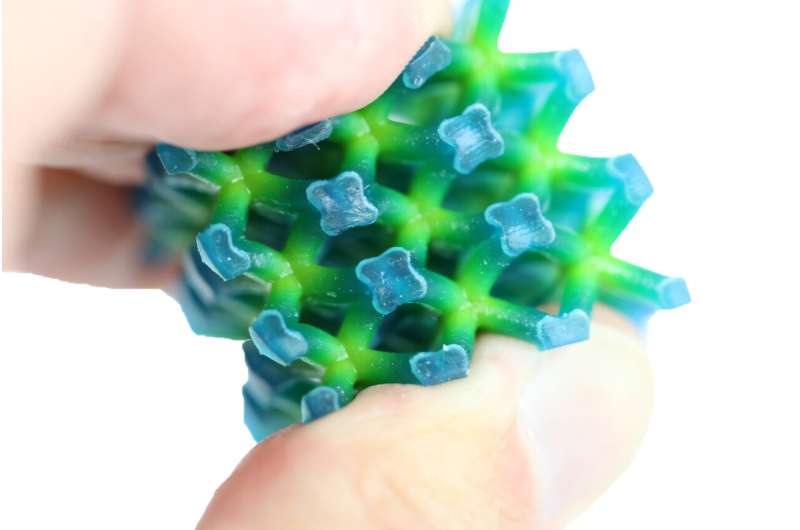
Designing objects with smoothly varying or multiple materials has traditionally strained standard CAD tools, which treat interiors as uniform. In a new development, a team at the University of Colorado Boulder’s Matter Assembly Computation Lab (led by Robert MacCurdy) has launched OpenVCAD, a code-based design system that allows engineers to assign functions to shape and material variation within a 3D object, tells Tech Xplore.
OpenVCAD works by letting the designer define spatial functions or gradients that map points in space to specific materials or blends thereof. Rather than redrawing geometry each time, users can tweak a variable and have the entire design update. This makes expressing transitions, say, from stiff to soft, smoother and faster. One application is graded lattice structures, where you might want high stiffness in some zones and compliance in others. The tool even supports up to five materials in a single print run, given an appropriately capable printer.
Beyond just generating designs, OpenVCAD simplifies downstream workflows. It can export outputs directly for slicing and production. Its flexibility also makes it useful across domains: soft robotics, medical models, structural designs with impact absorption zones, and more. The researchers argue that a major barrier to multi-material design has been the overhead of writing bespoke code for every new project. OpenVCAD aims to reduce that friction by providing infrastructure and primitives out of the box.
Because OpenVCAD is open source and ships with a Python implementation, it’s accessible to researchers and makers alike. The team hopes that community uptake will drive further improvements, integrations, and adoption across industries.
OpenVCAD promises to shift multi-material design from specialized, cumbersome workflows to fluid, expressive modeling, unlocking new possibilities in additive manufacturing.
