

In this article from Wired.com, physicist Rhett Allain walks readers through why spacecraft maneuvers in orbit often defy everyday intuition. He shows how three core physics concepts, i.e., centripetal acceleration, gravitational force, and Newton’s second law, determine the speed required for a circular orbit at any given radius.
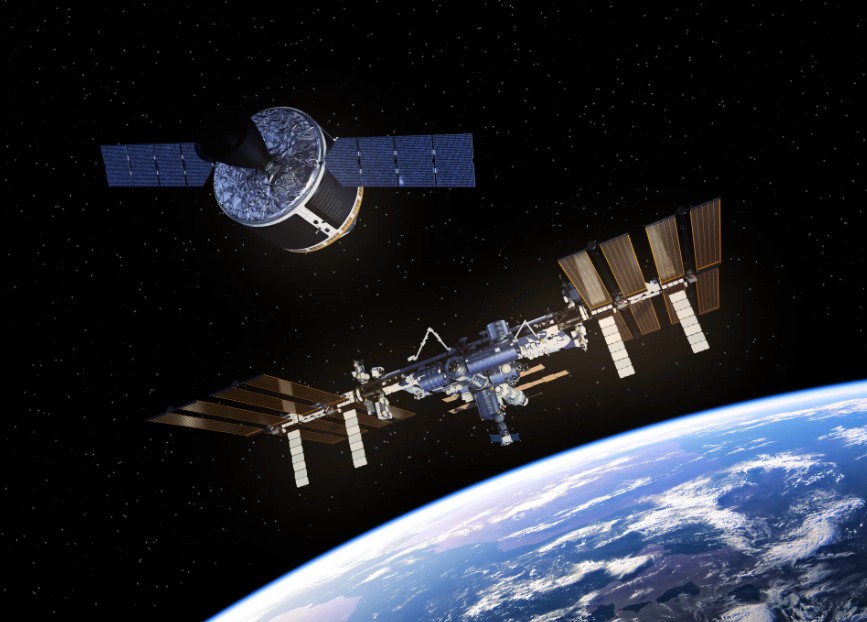
When a spacecraft travels strictly in a circular orbit, its velocity must match the radius of that orbit precisely; any deviation takes you out of that stable path. Allain then describes a scenario: you’re in a spacecraft behind a space station, planning to dock. You might think you should accelerate to catch up. However, firing your thruster forward increases your velocity, but also moves you into a higher orbit where the path is longer and you actually fall behind the station. On the flip side, if you fire your thrusters backwards (slowing down), you drop into a lower orbit. That orbit is shorter and faster, allowing you to catch up. This paradoxical notion is “slow down to speed up.”
The article explains the well-known orbital maneuver called the Hohmann transfer: a two-step change in orbit. First, you decelerate to shift into an elliptical path that crosses into a lower orbit, then at the periapsis, you speed up to match the lower circular orbit’s velocity. It’s a key tool for docking, interplanetary travel, and serious orbital engineering.
The takeaway for engineers and students: orbital flight isn’t intuitive; you can’t treat space like Earth’s atmosphere. Corrections and maneuvers follow their own logic. Understanding the physics, i.e., vector speeds, gravity fields, and elliptical orbits, is essential when designing spacecraft trajectories or planning missions.
Overall, the article gives a clear and surprisingly accessible explanation of an odd but fundamental aspect of orbital mechanics: sometimes, to go ahead, you must slow down.
