

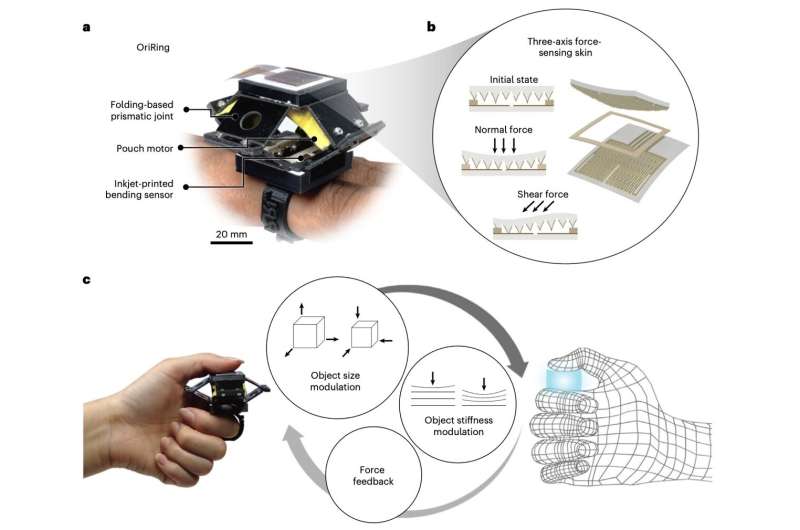
Researchers have developed a wearable haptic device that could transform how users feel virtual and augmented reality environments. Work published in Nature Electronics introduces an origami-inspired ring, called OriRing, that senses and reproduces the forces a wearer would feel when interacting with digital objects. Unlike typical VR and AR systems, which focus on sight and sound, this device adds a realistic sense of touch by detecting and transmitting pressing and sliding forces on the skin, tells Tech Xplore.
The ring weighs only 18 grams and uses a folding-based geometric design drawn from origami principles. Its structure efficiently transmits force feedback while keeping the device compact and comfortable. A soft, multi-layer force-sensing “skin” on the ring detects forces in multiple directions, thanks to microstructured surfaces and resistive sensors printed directly onto flexible materials. This arrangement allows the device to register both normal and shear forces on the user’s finger.
OriRing integrates soft pneumatic actuators that respond to real-time input from the sensors, pushing back against the user’s skin to simulate the stiffness and size of virtual objects. The ring can produce feedback with up to 6.5 newtons of force, enough to create perceptible sensations that align with visual and auditory cues in a virtual world. Crucially, the system supports bidirectional communication between the physical wearer and the digital environment, allowing users not only to feel but also to influence virtual object properties through digital commands.
The development reflects a broader push to make extended reality experiences more immersive and interactive by adding tactile and proprioceptive feedback. In early tests, the ring demonstrated the potential to replicate realistic touch sensations, suggesting applications beyond entertainment. In professional training, therapy, and remote collaboration, devices such as OriRing could help users gain a more complete sensory experience of virtual environments. Future work may expand the range of sensations and refine comfort and ergonomics for broader adoption.
