

Researchers have developed a new version of radiative cooling coating that cools building surfaces and improves fire safety, a combination that could make passive cooling technologies more viable for hot urban environments, tells Tech Xplore. Traditional radiative cooling materials work by reflecting incoming sunlight and emitting heat as infrared radiation, lowering surface temperatures without using energy. These coatings typically embed microscopic silicon dioxide (SiO₂) particles in a polymer resin used on roof and façade surfaces to reduce heat gain and energy needs for air conditioning.
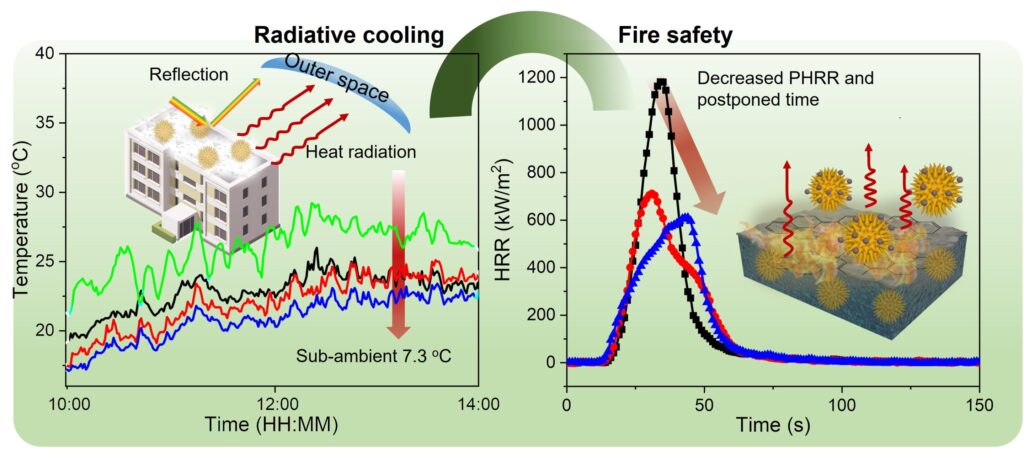
In research published in Nano Materials Science, the team modified the shape of the SiO₂ particles into a dendritic, tree-like structure. This engineered morphology increases the number of surfaces that scatter sunlight, raising solar reflectivity and infrared emissivity well above those of conventional particle shapes. Polymer composites with these dendritic particles achieved solar reflectivity of 95.5% and infrared emissivity of 94.5%. Under testing, these coatings reduced daytime surface temperatures by about 2°C more than existing coatings and by roughly 7.3°C compared to ambient temperature.
The new coating also addresses fire safety, a limitation of many passive cooling materials that focus narrowly on thermal performance. When heated, the dendritic SiO₂ spheres increased the polymer’s viscosity, trapping combustible gases and forming a barrier that slowed flame growth. Tests showed a nearly 48.4% reduction in peak heat release rate, meaning lower fire intensity and slower fire spread, which could improve evacuation conditions in a real fire.
By combining enhanced radiative cooling with improved fire resistance, the research team offers a material design that tackles both excessive heat and safety concerns in cities where heat waves, urban heat island effects, and building fire risk intersect. Such multifunctional coatings could help reduce energy consumption while boosting safety in hot urban environments, a growing priority as cities warm and passive cooling solutions gain attention.
