

Solar power has a strong environmental advantage over fossil fuels, but conventional photovoltaic panels create a growing waste problem at the end of their useful lives. Recycling can cost more than disposal, so many retired panels ultimately end up in landfills. A new solar panel design could address that problem by making panels much easier to dismantle and reuse, tells Forbes.com.
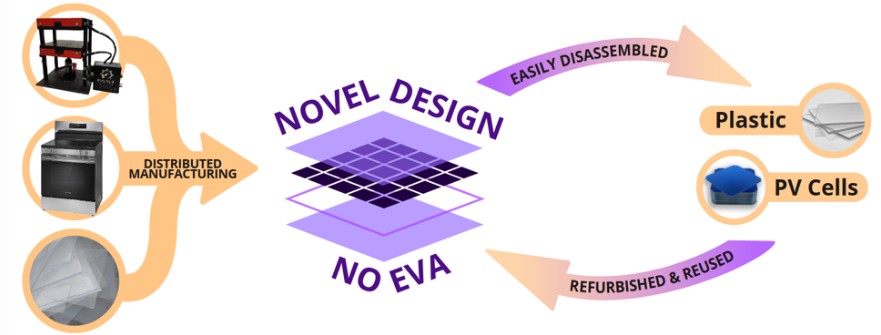
Researchers have investigated a laminate-free solar module that replaces conventional encapsulation with polycarbonate plastic. Standard photovoltaic modules typically use ethylene vinyl acetate, or EVA, to encapsulate cells. This lamination protects the cells but also makes separating components for recycling difficult. The experimental approach avoids that permanent bonding, allowing solar cells to potentially be recovered intact for reuse or refurbishment.
To evaluate the concept, researchers built single-cell mini-modules and subjected them to electrical, optical, mechanical, and environmental testing. The polycarbonate sheets transmitted about 80% of incoming light, considerably less than solar-grade glass. Despite this optical disadvantage, electrical measurements showed that the encapsulation process kept cell performance within 5% of initial measurements.
The modules also completed several mechanical tests based on IEC 61215-1:2021-02 requirements, including static and dynamic load assessments. They achieved the equivalent of an IP68 rating during underwater testing, indicating strong protection against water intrusion. Hail resistance, however, remains a major weakness. The modules failed hail testing, showing that additional development is necessary before the technology could be suitable for widespread deployment.
The main advantage is what happens when a panel reaches the end of its service life. Eliminating conventional lamination makes disassembly simpler and could allow valuable solar cells and other materials to remain in circulation rather than being destroyed during recycling.
Although the design still requires improvements in optical transmission and hail resistance, plastic-encapsulated panels demonstrate a different approach to photovoltaic sustainability. Instead of focusing only on generating clean electricity, future solar modules could be engineered from the beginning for recovery, refurbishment, and repeated material reuse.
