

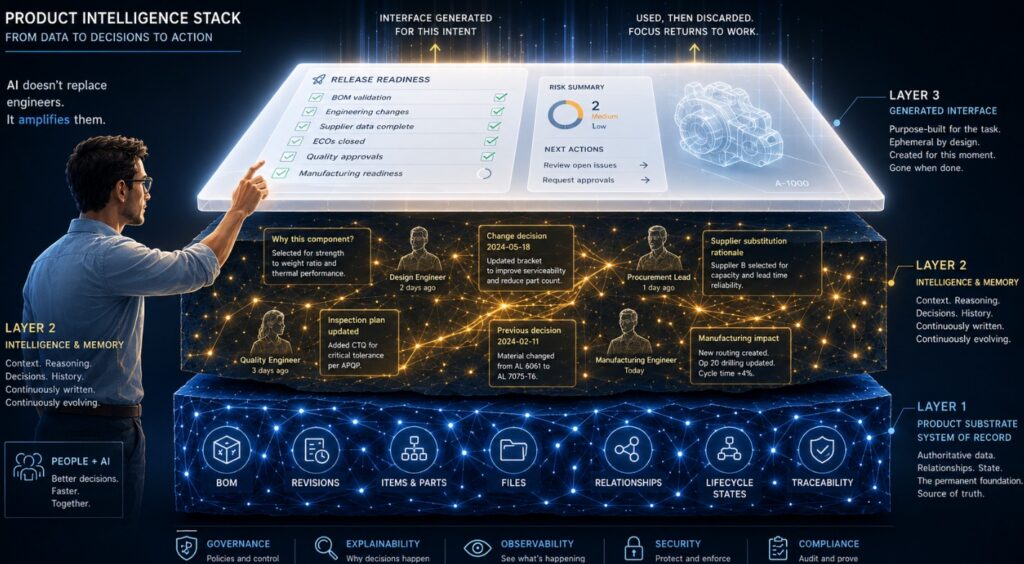
Oleg Shilovitsky’s article on Beyond PLM argues that the traditional concept of PLM user experience is rapidly becoming obsolete as artificial intelligence transforms enterprise software from interface-centric systems into agent-driven operational environments. Rather than improving dashboards, menus, and workflows incrementally, the next phase of PLM will rely on AI-native interactions where agents perform engineering tasks directly on behalf of users.
The article begins with a broader observation about enterprise UX trends. Conventional PLM systems were designed around forms, navigation trees, and structured processes that required engineers to manually search, organize, and validate data. In AI-native environments, however, the interface itself becomes less important because users increasingly interact through prompts, context-aware assistants, and autonomous agents. Instead of clicking through workflows, engineers describe objectives while AI systems gather information, validate requirements, and coordinate actions across systems.
Shilovitsky argues that this shift is particularly important in product lifecycle management because PLM has historically struggled with usability. Traditional PLM deployments often created friction through rigid workflows and complicated interfaces that engineers resisted adopting. AI agents, by contrast, could reduce that burden by acting as operational intermediaries between users and enterprise systems.
The article introduces the concept of “product memory” as the foundation of this transition. Rather than treating PLM as a static repository of files and records, product memory captures relationships, engineering intent, decisions, revisions, and operational context in a continuously evolving knowledge structure. AI agents can then use this contextual layer to perform meaningful work instead of merely retrieving documents.
Another major theme is the rise of “agentic UX.” In this model, the experience is defined less by visual design and more by how effectively AI agents execute tasks, maintain context, and collaborate with engineers. The future PLM experience may therefore depend more on orchestration, trust, and contextual awareness than on screens and interface layouts.
The article ultimately presents AI-native PLM as a structural change rather than a feature upgrade. As engineering systems evolve, PLM platforms may shift from passive data management tools into intelligent operational environments where human judgment and machine-driven execution work together continuously.
