

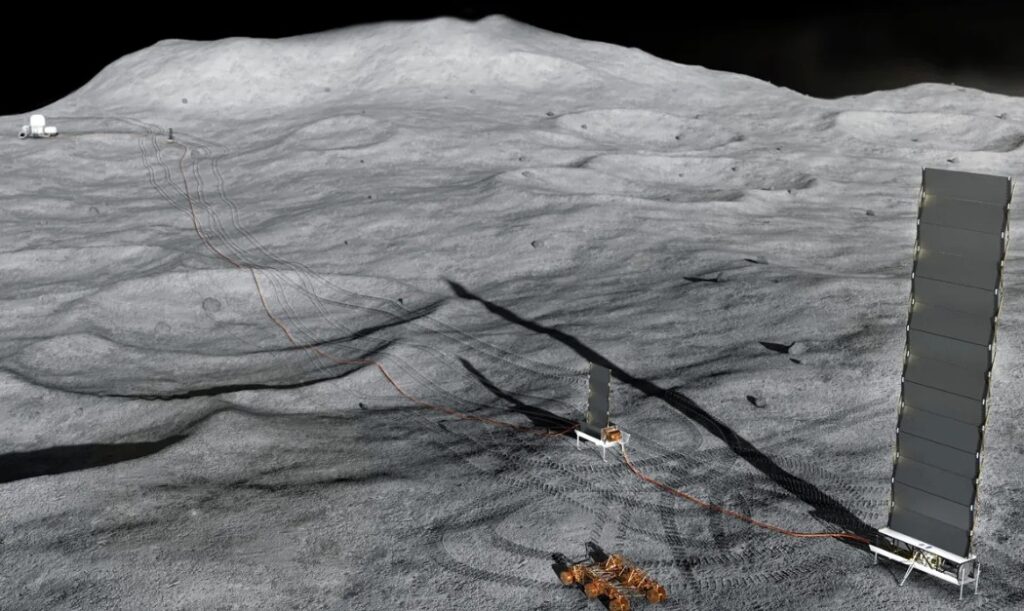
NASA and other space agencies are racing to put nuclear reactors on the moon. China and Russia have teamed up to complete one by 2036. In response, NASA aims to have its own ready by 2030.

Why the rush? Why does NASA want nuclear reactors on the moon in the first place? And how would they work? To find out the answers, in this interview, IEEE Spectrum spoke with Katy Huff, a nuclear engineer and the director of the Advanced Reactor Fuel Cycles Laboratory at the University of Illinois at Urbana-Champaign. Huff previously served as the assistant secretary for nuclear energy at the U.S. Department of Energy (DOE).
The moon is now seen as a place for long-term human stays, science, mining, and more. Scientists expect moon bases will need constant power. Solar power alone is not enough. The long lunar night lasts about 14 Earth days, and dusty solar panels perform poorly.
Nuclear reactors can deliver steady power no matter how long the night lasts. They have far greater energy density than solar or batteries. That makes them the best choice to keep lights on and machines running.
Here is how these lunar nuclear reactors would work. NASA’s Fission Surface Power (FSP) effort is building small fission reactors. They use uranium fuel and convert it into electricity. Cooling and heat rejection happen through radiators. Some parts are buried for safety and shielding.
NASA is asking industry for ideas now. They aim to deploy a 100-kilowatt reactor. That is enough power for a small settlement or lab. Contracts have already been awarded to companies such as Lockheed Martin, Westinghouse, and X-Energy for earlier phases.
Such a nuclear power plant would allow people to stay on the moon longer. It would power lights, life-support, rovers, 3D printers, and mining operations. It could also support extracting local resources such as water ice.
There are strategic reasons, too. The first country to land a reactor could gain a de facto “keep-out zone” on the lunar surface. That makes it easier to secure territory for the Artemis program or research outposts.
To sum it all up, nuclear reactors on the moon are needed to solve power gaps that solar cannot. They turn the moon into a place where engineers can build, explore, and live reliably.
