
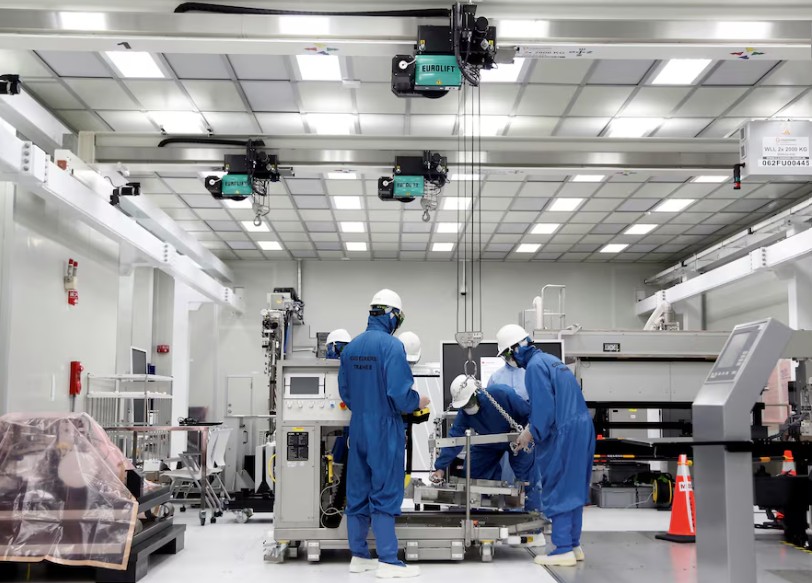
A critical bottleneck in semiconductor manufacturing is being redefined by advances in extreme ultraviolet lithography. The latest developments from ASML Holding focus on boosting the power of extreme ultraviolet (EUV) light sources, a move that could significantly increase chip production efficiency and unlock further scaling at advanced nodes, tells Reuters.com (requires free registration).
EUV lithography sits at the heart of modern chipmaking, enabling the patterning of extremely small features required for high-performance processors. Unlike older techniques, EUV uses light with a wavelength of just 13.5 nanometers, allowing manufacturers to print finer circuit details in fewer steps. However, generating this light reliably and at high power has remained one of the most complex engineering challenges in the field.
Recent progress centers on increasing the output of EUV light sources from roughly 600 watts toward 1,000 watts. While the numbers may appear modest, the impact on manufacturing is substantial. Higher power reduces the time required to expose each wafer, directly increasing throughput. As a result, chipmakers could produce significantly more chips per hour, with projections suggesting up to a 50% increase in output over the coming years.
The underlying process is remarkably intricate. EUV light is produced by firing high-energy lasers at microscopic tin droplets, creating a plasma that emits the desired wavelength. This requires extreme precision in timing, positioning, and energy control, along with advanced mirror systems capable of reflecting EUV radiation in near-vacuum conditions. Even minor inefficiencies can ripple through the system, limiting performance.
For engineers, the implications extend beyond faster chips. Improvements in EUV power reduce the need for multi-patterning steps, simplify fabrication workflows, and lower the cost per transistor. They also support continued scaling toward sub-2-nanometer nodes, which are essential for next-generation AI and high-performance computing applications.
The evolution of EUV highlights a broader shift in semiconductor innovation. Progress now depends less on isolated component improvements and more on tightly integrated systems that combine optics, plasma physics, materials science, and precision engineering into a single, highly coordinated platform.
