

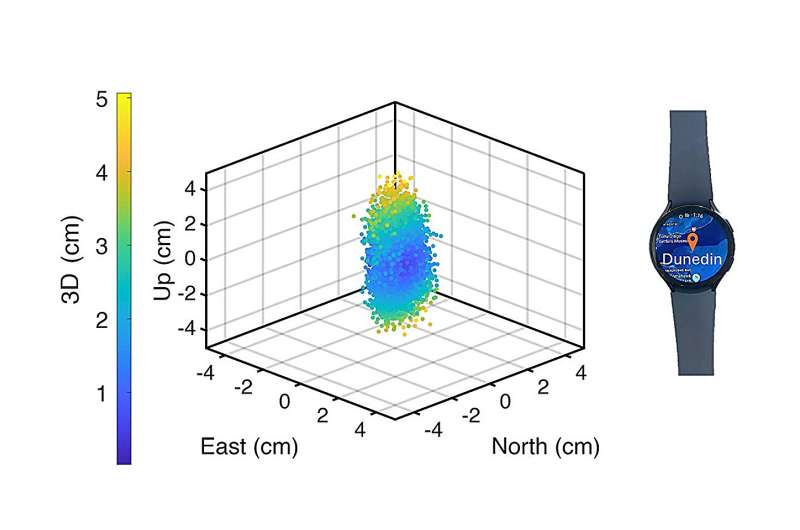
A team at the University of Otago, collaborating with Google’s Android Context group and the Chinese Academy of Sciences, has produced algorithms that elevate smartwatch global navigation satellite system (GNSS) accuracy to the centimeter scale. They achieved this by capturing carrier-phase signals from multiple satellite constellations and adapting them for a wearable form factor, reports Tech Xplore.
Historically, carrier-phase positioning demanded expensive hardware and high-consumption antennas, beyond the reach of consumer wearables. The study demonstrated that a standard smartwatch (with a diameter of about 4 cm) could deliver repeatable positioning within about 8 cm over a 4-hour stationary run. That marker of precision is impressive: for context, earlier wearables typically achieved meter-level error at best.
The researchers used the Google GnssLogger app and combined signals from GPS, Galileo, BeiDou, and other GNSS systems. They refined algorithms that account for atmospheric delays, cycle-slips, and the challenges of wrist-worn antennae. Effectively, they brought “survey-grade” accuracy into a wrist-device form, under controlled conditions.
While the advance is significant, it comes with caveats. The tests required ideal conditions, i.e., a stationary setup, open sky view, and specialized logging. The team acknowledges that applying the method during movement, indoors, or in urban “canyons” will pose further challenges.
The implications are broad. For fitness tracking, outdoor navigation, asset monitoring, and augmented-reality wearables, centimeter accuracy on the wrist could unlock new applications: edge-to-edge mapping, refined location services, and better safety features. It also signals how wearables are closing the gap with professional GNSS gear.
This work marks a leap for wearable positioning: smartwatches aren’t just tracking rough location anymore; they’re heading toward high-precision positioning, bringing possibilities once restricted to specialist equipment into everyday devices.
