

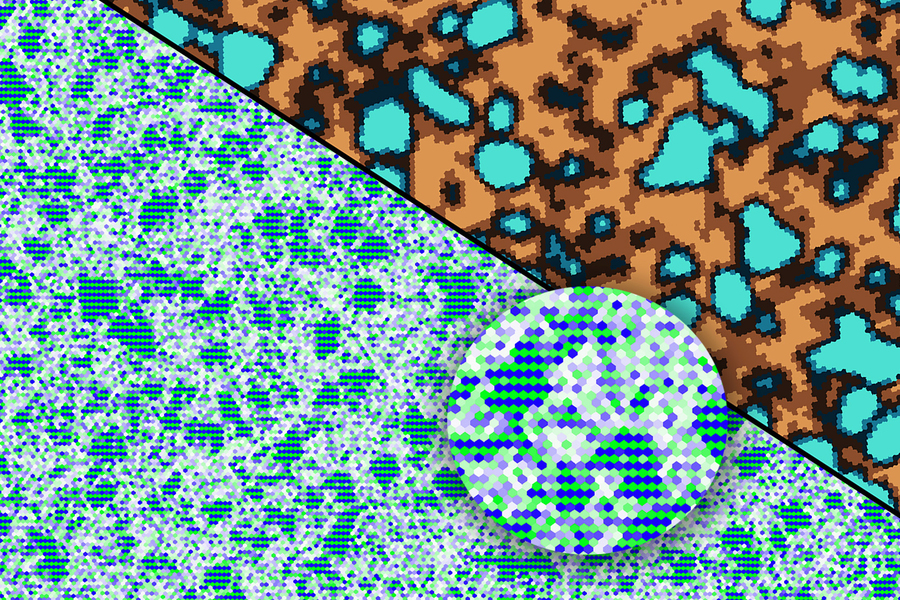
Researchers at MIT have created an aluminum alloy tailored for additive manufacturing that achieves strength levels previously unseen in printable metals. Their approach combines simulations, machine learning, and rapid solidification to produce an alloy with nanometer-scale precipitates that confer exceptional mechanical performance, says MIT News.
The team began by exploring vast compositional spaces, aluminum mixed with various alloying elements, using a machine learning model that filtered millions of possibilities to just 40 candidate formulas. That cuts the search space dramatically versus brute-force simulation. The winning formula produced an alloy whose microstructure featured a high volume of very small precipitates, a key to strength at the nanoscale.
To physically realize this alloy, the researchers used laser powder bed fusion (LPBF), a 3D-printing method whose rapid melting and cooling cycles help lock in fine precipitate structures. The fast cooling is essential: slower cooling, as in conventional casting, lets precipitates grow and weaken the material.
When they tested samples of this printed alloy, the results validated the predictions: the new alloy was five times stronger than its cast equivalent, and about 50% stronger than alloys designed without machine learning assistance. It also maintained structural stability at elevated temperatures up to 400°C.
The implications are broad and significant. In aerospace, fan blades and structural components could switch from titanium or heavy composites to this lightweight, high-strength aluminum, cutting weight and cost. Beyond that, the alloy could find use in data center cooling hardware, high-end automobiles, vacuum systems, and more.
The methodology also points the way forward: combining physics-based modeling with data-driven optimization accelerates materials discovery. The team plans to apply similar strategies to optimize other properties, beyond strength, for printable alloys.
