

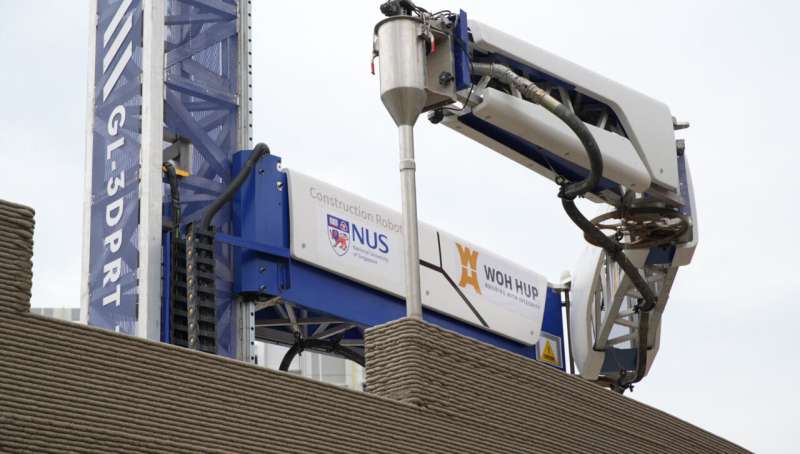
Researchers at the National University of Singapore have demonstrated that three-dimensional concrete printing can play a meaningful role in mainstream construction by fabricating structural elements that meet performance requirements while reducing labor, material use, and carbon emissions. The work targets key limits that have kept 3D concrete printing (3DCP) largely confined to non-structural parts and low-rise applications, says Tech Xplore. In dense urban environments, conventional construction is slow, labor-intensive, and wasteful, and 3DCP’s automation and lack of formwork offer an alternative with faster delivery and greater design flexibility.
The NUS team, led by civil engineers Du Hongjian and Pang Sze Dai, focused on materials and process innovations that make printing structural components viable in real-world projects. They developed printable concrete formulations that flow well through extrusion, set rapidly to support overlying layers, and remain compatible with reinforcement strategies. Those formulations help eliminate the need for traditional wooden or steel formwork, which accounts for significant material waste and labor costs in conventional casting.
The project was undertaken with industry partner Woh Hup and backed by national platforms including the Building and Construction Authority and the National Additive Manufacturing Innovation Cluster. Their collaborative approach embeds digital fabrication into existing construction workflows rather than confining it to laboratories. By aligning 3D printing with standard practices for reinforcement and load-bearing design, the researchers have removed a key barrier to adoption.
The environmental upside of 3DCP comes from reduced material use and waste, improved precision, and lower manpower needs. Studies on 3D printed houses show reduced embodied carbon and water use compared with traditional methods, pointing to broader sustainability gains when this technology scales.
As construction sectors worldwide seek to cut greenhouse gas emissions and labor costs, this research shows that 3DCP can evolve beyond demonstrations to technologies capable of producing structural building elements at scale. Continued work on materials, reinforcement, and process integration will determine how quickly 3DCP reshapes mainstream construction practice.
