

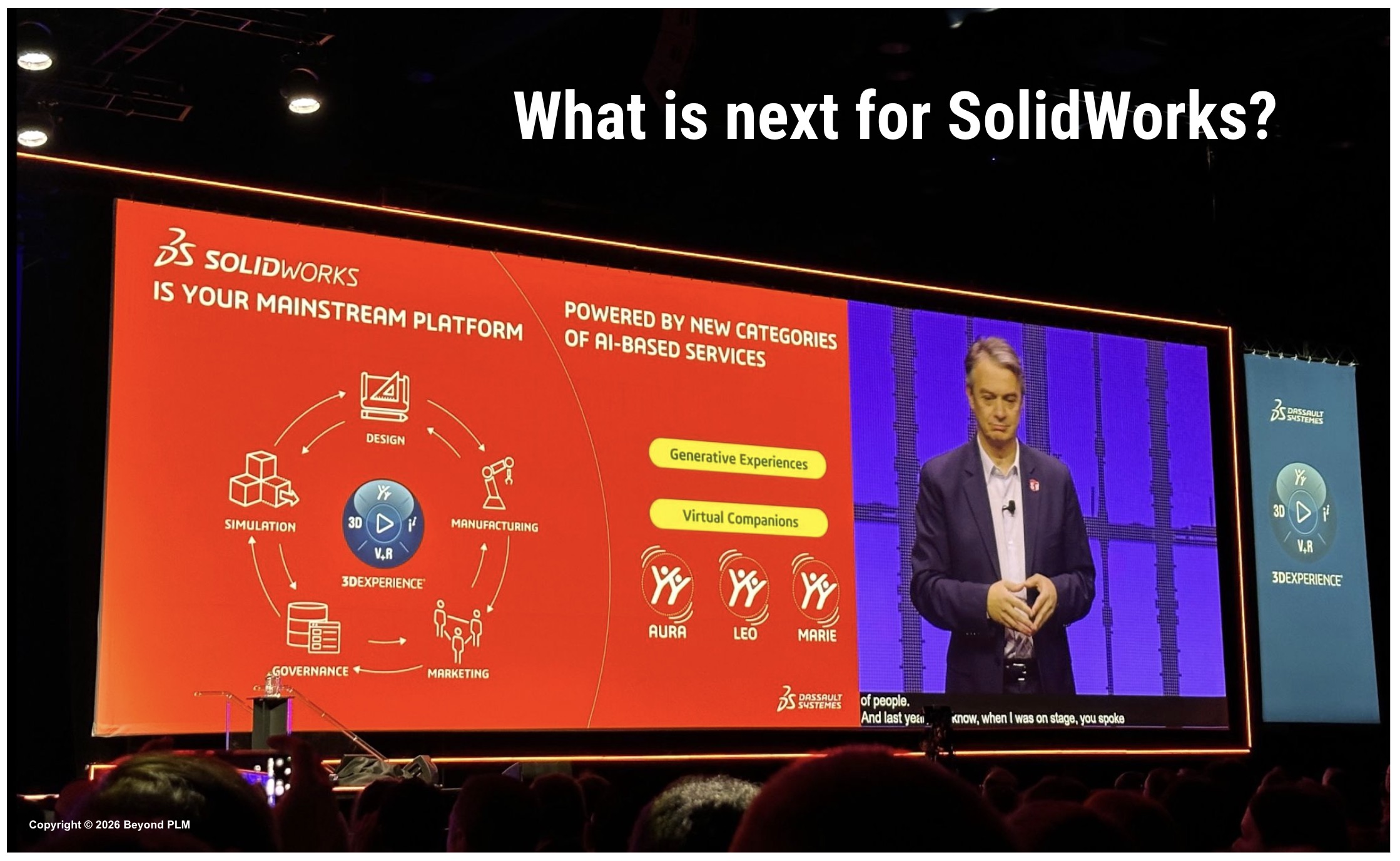
At 3DEXPERIENCE World 2026 in Houston, observers of the SolidWorks community felt a tension between long-standing ecosystem strengths and the broader platform ambitions of Dassault Systèmes. The SolidWorks ecosystem, built over more than three decades, remains a mature and resilient part of the mechanical CAD landscape, supported by widespread familiarity, a vast trained workforce, and rich third-party tooling that grew up around its file-based workflows. That file-centric DNA, deeply embedded in engineering habits, process flows, supplier interactions, and partner integrations, has been a key factor in SolidWorks’ long success and helps explain why change in this arena tends to unfold slowly, says Beyond PLM Blog.
Dassault’s strategic pivot toward the 3DEXPERIENCE platform represents a broader vision in which product data, traceability, and lifecycle context are as important as geometry. The idea is to unite mechanical, electrical, software, and manufacturing information in a consistent framework that extends beyond traditional files. But this transition collides with practical realities: decades of data, habits, and systems built around files won’t be displaced quickly by platform logic, even if the software architecture promises greater integration and collaboration.
One increasingly visible trend is a search for a new “center of gravity” in engineering workflows, not another CAD tool or a monolithic PLM system, but the data layer itself. Engineers and organizations are paying more attention to connected product information that can bridge disparate systems and domain knowledge, a shift that aligns with broader industry demands for reuse, visibility, and productivity beyond geometry creation. This product-data focus emphasizes structured information, decision history, suppliers, configurations, and relationships rather than files alone.
Emerging tools and vendors are experimenting with solutions that connect data across systems instead of replacing core CAD or PLM tools outright. Artificial intelligence is seen as an amplifier of value when applied to connected product memory, enabling better insights, automation, and decision support. The article suggests that innovation is happening between systems, at the data layer, rather than within a single dominant platform.
Ultimately, the next shift in the SolidWorks ecosystem will likely be incremental and multifaceted, with cloud platforms evolving alongside file-based habits and data-centric approaches becoming more prominent as a foundation for engineering productivity and collaboration.
