

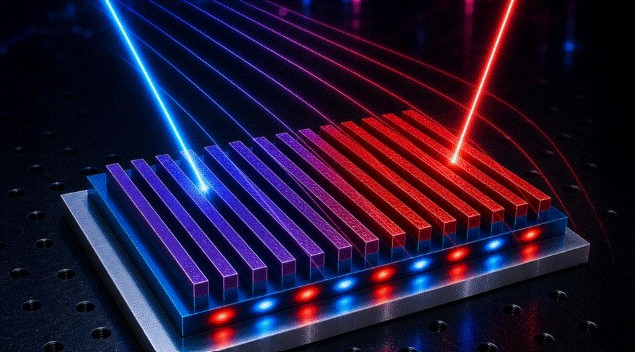
Researchers have developed a material that can actively control heat instead of simply conducting or insulating it, marking an important step toward programmable thermal technologies. Unlike conventional materials with fixed thermal properties, the new system can store different heat emission states, switch between them, and retain those settings without requiring a continuous power supply. The advance could improve infrared sensing, energy management, optical memory, and thermal communication systems, tells Science Daily.
The breakthrough relies on phase change materials, which alter their physical structure when exposed to electrical or optical signals. Each structural state changes the way the material emits thermal radiation. Once programmed, the material maintains its thermal behavior until it is deliberately reconfigured, creating a nonvolatile thermal memory similar to the way flash memory stores digital information. This ability eliminates the need for constant energy input to preserve its operating state.
Researchers demonstrated that the material can generate multiple programmable thermal emission patterns, enabling dynamic control over infrared radiation. Instead of producing a fixed thermal signature, the surface can be adjusted to emit different levels of heat depending on the application. Such flexibility could improve infrared imaging systems, adaptive camouflage, thermal displays, and devices that communicate using heat rather than electrical signals.
The technology also offers opportunities for more efficient energy systems. Smart thermal surfaces could regulate heat flow in buildings, industrial equipment, and electronic devices, reducing energy losses and improving temperature management. The ability to precisely tailor thermal emission may also support next-generation photonic computing and memory devices that use light and heat alongside conventional electronics.
Although further engineering is needed before commercial deployment, the research demonstrates that thermal radiation can be programmed with the same level of control traditionally associated with electrical signals. This capability expands the design possibilities for future electronic, photonic, and energy technologies, offering engineers a new way to manipulate one of the most fundamental forms of energy.
