

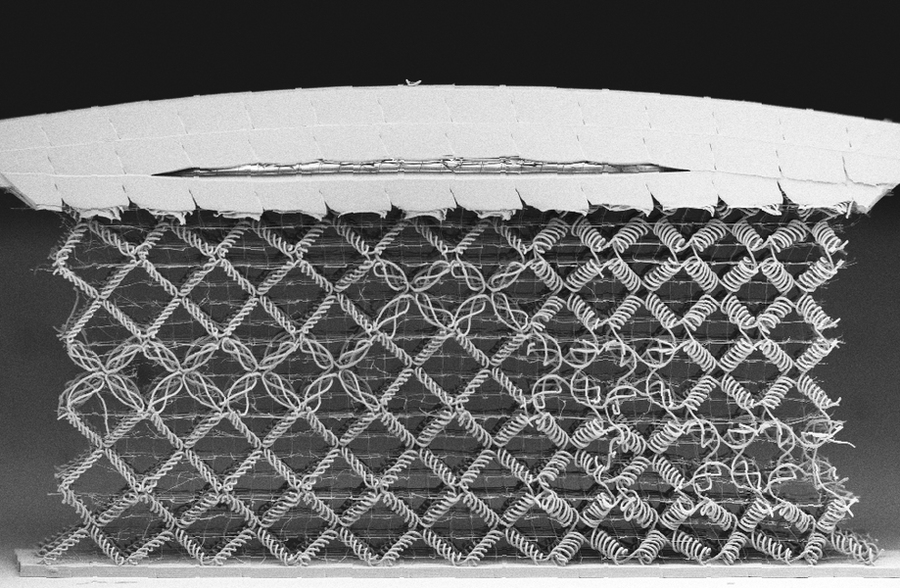
Researchers at the Massachusetts Institute of Technology have developed a computational design framework that makes it possible to 3D-print metamaterials with programmable deformation and failure characteristics, opening new possibilities in soft, compliant structures, tells MIT News. Traditionally, metamaterials, that is, engineered materials whose behavior is dominated by internal microstructure rather than chemical composition, have been designed for stiffness and strength. The new work focuses instead on creating soft, deformable materials that can stretch, bend, and even fail in predictable ways.
The research, published in the journal Nature Communications, introduces a universal design framework that encodes complex woven microarchitectures into metamaterials. These “3D woven metamaterials” are composed of intertwined fiber-like building blocks that self-contact and entangle, giving designers control over how the material responds to external forces. This level of control lets engineers tune stiffness, flexibility, and failure behavior across a broad range of mechanical responses.
A key innovation is representing the internal topology of these materials using graph-based algorithms that dictate fiber placement and connection. This approach lets designers create functionally graded lattices in which different regions of the material can be softer or stiffer as required. The framework also includes simulations that predict how the material will deform and fail under load, capturing complex phenomena such as fiber entanglement and self-contact.
MIT’s team made their framework open source, allowing others to generate 3D-printable designs tailored to specific applications. Potential uses span wearable sensors that conform to human movement, flexible textiles for aerospace or defense, soft robotics components, and biomedical devices that must endure large, non-linear deformations.
By giving engineers tools to predict deformation and failure before fabrication, this work overcomes limitations of manual metamaterial design and expands the range of achievable material behaviors. It marks a step toward mechanical materials that behave more like engineered systems than static solids, tailored to meet the demands of emerging technologies.
