

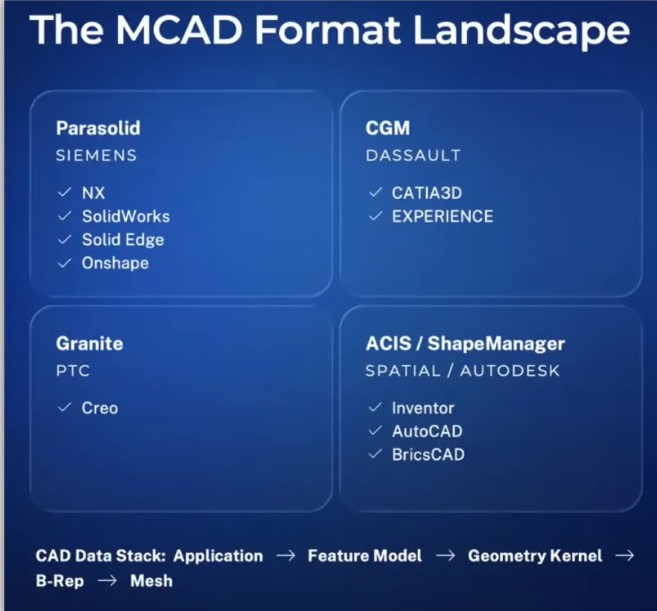
Proprietary file formats remain central to CAD not because of inertia, but because they solve problems that open or neutral formats cannot fully address. The article from the WorldCAD Access blog explains that these formats are deeply tied to the way CAD systems are built, evolve, and compete.
One of the primary drivers is control. Proprietary formats allow software vendors to retain ownership over how design data is structured and accessed. This creates a form of user lock-in, ensuring that customers continue using the same platform to open and edit their files. The article notes that this has long frustrated users, even prompting efforts in the 1990s to reverse-engineer formats like DWG so that data could be accessed more freely.
At the same time, proprietary formats are not just about restricting access. They are also necessary for handling the growing complexity of CAD systems. As software evolves, new features, modeling kernels, and data structures must be stored accurately. This leads vendors to design formats tailored to their own architectures, which often cannot be cleanly translated into other systems without loss or inconsistency.
The article also highlights that even CAD vendors struggle with interoperability internally. Mergers and acquisitions frequently bring together systems built on different modeling kernels, forcing companies to develop translators between their own products. These translations are rarely perfect, revealing that the problem is not just competitive but technical.
Competition further reinforces fragmentation. Vendors differentiate their products through unique capabilities, and proprietary formats become a way to encode and protect those differences. Efforts to move users between platforms often fail when compatibility is incomplete, as seen when poor round-trip translation discourages migration.
The result is a persistent ecosystem where proprietary formats dominate despite ongoing efforts toward openness. Rather than disappearing, they continue to evolve alongside CAD software itself.
In practice, proprietary formats are not a temporary limitation but a structural reality, balancing innovation, control, and the ongoing challenge of interoperability.
