

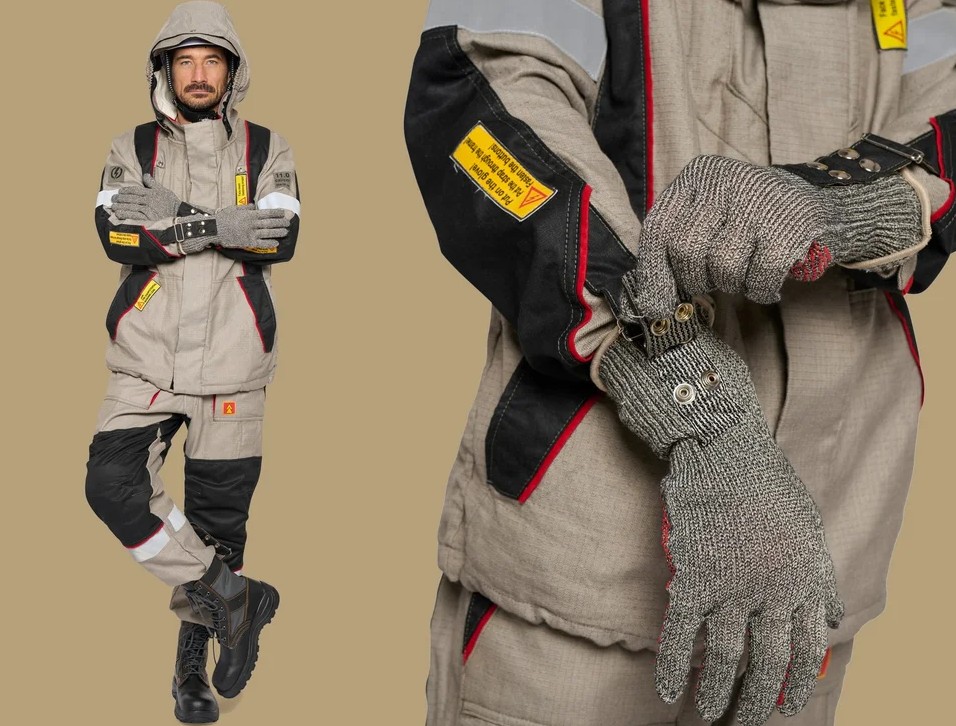
A new type of conductive protective suit promises to make high-voltage transmission line work safer by shielding technicians from dangerous induction currents that can pass through their bodies during maintenance tasks, tells IEEE Spectrum. Standard protective equipment for live-line work already includes gear designed to block direct contact with energized conductors, but it offers limited protection against induced currents, that is, electric flow generated in de-energized lines by nearby live circuits. Those invisible currents have caused hundreds of accidents in the United States and elsewhere, including fatal shock incidents in which workers contacted seemingly safe conductors that were energized through induction.
The suits, developed by Budapest-based Electrostatics and distributed in the United States by Electrical Safety Consulting International, use interwoven conductive materials such as stainless-steel threads to form an effective Faraday cage around the wearer. This conductive mesh helps redirect induced current away from the body and across the suit’s outer surface. Low-resistance straps link the jacket, trousers, gloves, and socks, providing controlled paths for current to follow in the event of induction contact. The design aims to keep body exposure below the “let-go” threshold of roughly six milliamperes, above which muscles can lose control, trapping a worker in a dangerous condition.
Field versions of the suit are rated to withstand up to 100 amperes for short intervals, and built-in insulation addresses heat and potential arc flame hazards. At around $5,200 in the United States, the suits have been adopted by more than a dozen transmission operators in North America, Europe, Canada, Indonesia, and Turkey.
The motivation for the technology grows as grid operators increase transmission capacity by placing more circuits into existing corridors, which raises the likelihood of induction incidents. Developers and safety advocates hope that wider adoption and the development of industry standards for induction safety gear will help prevent serious injuries and fatalities among line workers.
