

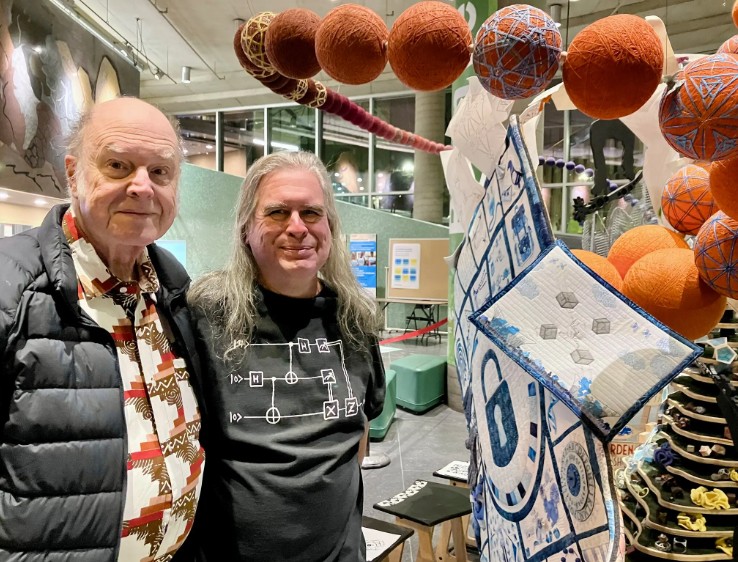
In the mid-1980s, Charles Bennett and Gilles Brassard introduced quantum cryptography, a concept that reimagined data security through the laws of quantum mechanics. At the time, their work was largely theoretical, but four decades later, it is emerging as a cornerstone of future digital security. Their contributions were recently recognized with the Turing Award, one of the highest honors in computing, reports The New York Times.
Their breakthrough, known as BB84, uses photons to generate encryption keys. The defining feature of this approach lies in quantum behavior: observing a photon alters its state. This means any attempt to intercept or measure the encryption key leaves detectable traces, making the system fundamentally resistant to undetected hacking. Unlike classical encryption methods, which rely on computational complexity, quantum cryptography is grounded in physical laws.
The significance of their work became clearer in 1994 when Peter Shor demonstrated that sufficiently powerful quantum computers could break widely used encryption systems. This discovery underscored the vulnerability of traditional cryptography and highlighted the need for quantum-secure alternatives. Bennett and Brassard’s earlier work provided exactly that.
Their research also extended into quantum teleportation, a method of transmitting information using entanglement, where two particles remain linked regardless of distance. This concept, once dismissed by Albert Einstein as “spooky action at a distance,” now forms the basis for secure quantum communication networks. These networks could enable data transfer between quantum computers without risk of interception.
As companies such as Google and Microsoft advance quantum computing, the need for secure communication systems becomes urgent. Governments and industries are increasingly investing in quantum cryptography to protect sensitive data against future threats.
What began as an abstract idea during a conversation between two researchers has evolved into a critical technology. Bennett and Brassard’s work not only anticipated the risks posed by quantum computing but also laid the foundation for a new generation of secure communication systems built on the principles of physics itself.
