

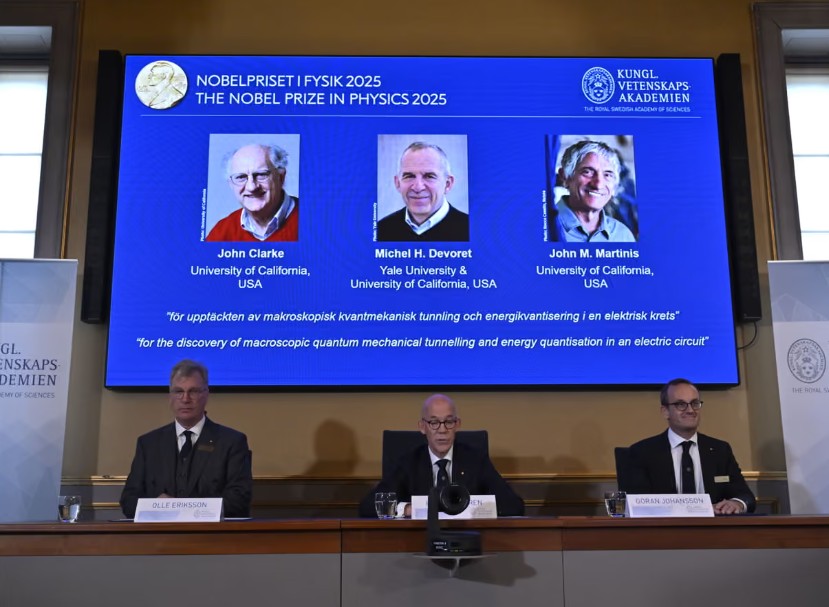
The 2025 Nobel Prize in Physics has been awarded to three researchers, John Clarke, Michel Devoret, and John Martinis, for experiments that brought quantum phenomena into the macroscopic world. In the 1980s, in Clarke’s Berkeley lab, the trio showed that behaviors once thought impossible beyond atoms, such as quantum tunneling and discrete energy levels, could occur in superconducting circuits, tells The Guardian.
Their work centered on Josephson junctions, circuits made by sandwiching a thin insulator between superconductors. Even though classical physics would treat that barrier as impenetrable, the team found that current could “tunnel” through, causing voltage changes that conformed to quantum rules. By measuring when and how these transitions occurred, they confirmed that energy quantization and probabilistic quantum laws applied at scales large enough to engineer.
Why does it matter? Because these discoveries form the foundation of superconducting qubits, the building blocks of many quantum computers today. Their experiments demonstrated that quantum mechanics could be harnessed, controlled, and scaled, a prerequisite for real applications such as quantum cryptography, sensing, and computation.
In accepting the prize, Clarke remarked on his surprise, saying he never expected the discoveries to lead to a Nobel. The Nobel committee highlighted how the work bridges fundamental physics and powerful new technology, a recognition that quantum mechanics continues to yield both profound insights and practical innovations.
As quantum systems move from labs into computing centers and communication networks, the laureates’ work reminds us: the weird laws of the quantum world aren’t locked in abstraction. They can extend into the circuits we build, opening a path where atoms and machinery follow the same surprising rules.
