

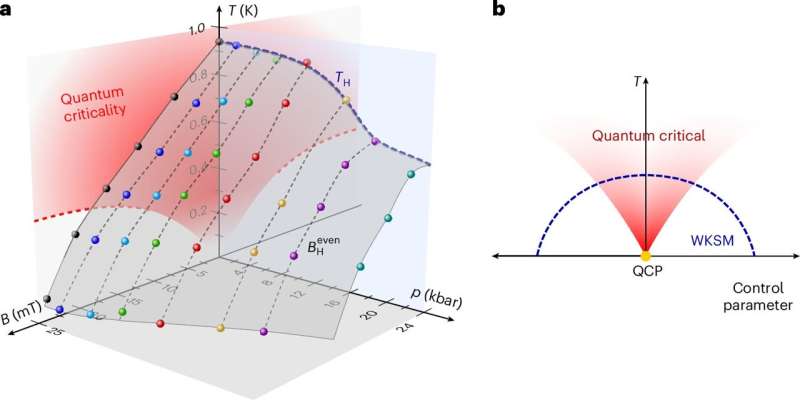
Researchers have identified a previously unknown quantum state of matter that bridges two major, but traditionally separate, areas of physics: quantum criticality and electronic topology, tells Tech Xplore. The work appears in Nature Physics and was co-led by scientists at Rice University, including physicist Qimiao Si. The team’s findings show that under certain conditions, strong interactions among electrons can generate topological behavior rather than suppress it, which challenges longstanding assumptions in condensed matter physics.
Quantum criticality describes how electrons fluctuate between different phases, similar to water being on the verge of freezing or boiling. Electronic topology, on the other hand, deals with stable features in the wave nature of electrons that remain unchanged even when a material’s structure is altered. Prior to this discovery, these phenomena were treated as largely distinct. Researchers developed a theoretical model to predict electron behavior when both strong interactions and topological effects are present. They then confirmed signatures of this new state in experiments using a heavy fermion material, where electrons act as though they are much heavier due to intense interactions.
The hybrid quantum state has important implications for future technologies. Topological materials are known for their resilience to disorder, and quantum criticality enhances entanglement—both qualities are desirable for devices such as quantum computers and ultra-sensitive sensors. By showing that these effects can coexist and reinforce each other, the study suggests new routes for designing quantum materials that are both robust and highly tunable.
Significantly, this discovery provides a framework for researchers to look for or engineer materials at quantum critical points that also exhibit topological features, potentially accelerating progress in quantum computing, sensing, and low-power electronics.
