

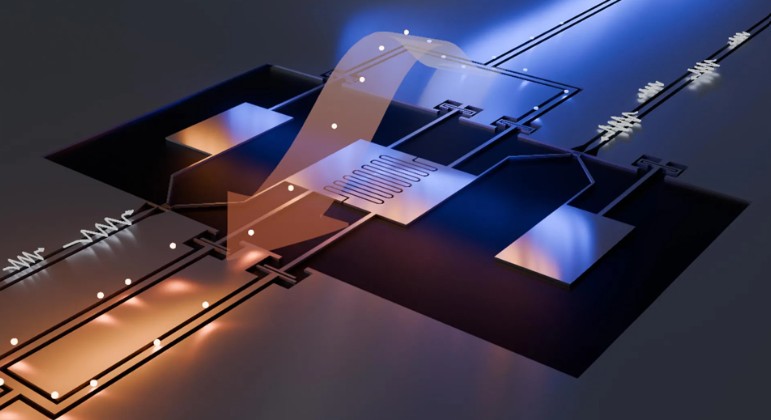
Quantum computers must operate at temperatures close to absolute zero to maintain the fragile quantum states that enable their extraordinary potential. Until now, cooling systems have relied on bulky refrigerators that suppress heat and noise but also introduce disturbances that can destroy the delicate information stored in qubits. Researchers at Chalmers University of Technology in Sweden have developed a radically different approach: a minimal quantum refrigerator that uses noise as its driving mechanism instead of fighting it, turning a long-standing challenge into an asset, tells Science Daily.
At the heart of the new system is an artificial superconducting molecule connected to multiple microwave channels that act as hot and cold heat reservoirs. Controlled microwave noise, typically seen as harmful, is injected into the system in a narrow frequency range. This carefully steered noise actively drives heat transport between reservoirs, enabling the device to function as a refrigerator, a heat engine, or an energy amplifier within the quantum circuit itself.
The innovation stems from the idea that random thermal fluctuations can be harnessed for cooling, a concept known as Brownian refrigeration. The device demonstrated precise control over extremely tiny heat flows, on the order of 10⁻¹⁸ watts, by leveraging noise to regulate energy movement inside the quantum circuit. This level of control is especially important for scaling quantum systems, where local heat generated by qubit operations can destabilize quantum information if not properly managed.
By integrating cooling directly into the quantum circuitry, the new refrigerator could reduce reliance on traditional cryogenic infrastructure that occupies valuable space and limits scalability. Managing heat at such minute scales opens doors to more robust and scalable quantum machines, a key step toward realizing practical quantum computing.
This work, published in Nature Communications, points to a future where quantum devices manage thermal challenges internally and where noise becomes a functional tool instead of a persistent barrier.
