

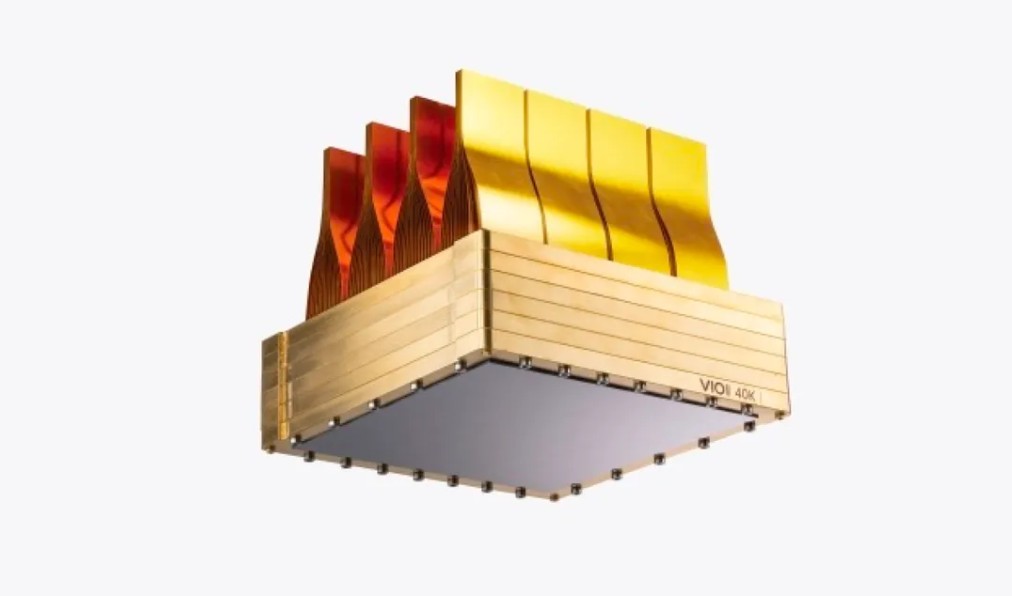
Researchers and engineers aiming to make quantum computers practical have a major hardware challenge: wiring and connecting qubits in a way that lets them scale to useful sizes. Traditional quantum chips lay out wiring horizontally, much like classical processors, and this limits how many qubits you can fit before connections become tangled and slow. QuantWare, a quantum hardware company, says it has developed a new three-dimensional wiring architecture that could support up to 10,000 qubits on a single quantum processor unit (QPU), roughly 100 times more than the roughly 100-qubit chips from Google and IBM that represent the current state of the art, tells Live Science.
The new design, dubbed VIO-40K, uses vertical wiring lines and modular “chiplets” that plug into a dense 3D structure. This lets signals travel to and from qubits without the bottlenecks that plague traditional, flat designs. By stacking and integrating high-fidelity connections across layers, QuantWare can pack many more input and output lines in a given footprint and maintain signal quality. The company says this approach overcomes a major roadblock in superconducting quantum computing and moves the field closer to processors that could handle complex simulations and real-world problems.
QuantWare plans to build a large quantum fabrication facility in Delft, Netherlands, by 2026 and begin shipping processors built on this architecture by 2028. Its strategy differs from competitors that build full quantum systems. Instead, QuantWare promotes an open ecosystem where its QPUs work with other firms’ components and software platforms, including Nvidia’s NVQLINK and CUDA, to bridge quantum and classical computing. That compatibility could help researchers and developers integrate these powerful chips with existing computing infrastructure.
This isn’t a commercial product yet, and real-world performance remains to be demonstrated. But the concept highlights one way quantum hardware might break through current size limits and accelerate progress toward large-scale quantum computing.
