

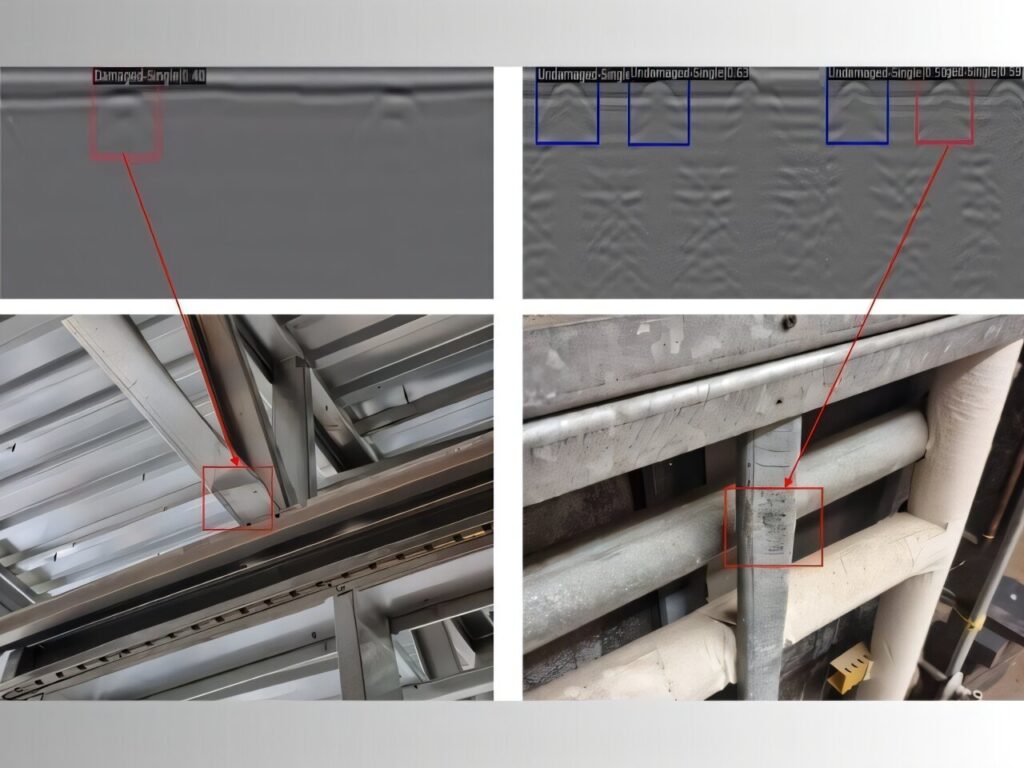
Cold-formed steel is widely used in modern construction because it is lightweight, economical, and easier to work with than traditional hot-rolled steel. Today, it appears in roughly one-third of nonresidential buildings in the United States, often forming the internal framework behind drywall or other wall coverings. Yet inspecting these structural elements poses a persistent challenge: the steel is hidden inside walls, making damage difficult to detect without destructive and costly methods.
Researchers at the University of Houston have introduced a new approach that combines ground-penetrating radar (GPR) with artificial intelligence to identify concealed structural damage in cold-formed steel members, tells Tech Xplore. Instead of tearing open walls to inspect studs or joists, inspectors can scan the wall surface with radar. The system then analyzes the reflected signals to locate steel components and identify abnormalities that may indicate damage.
The technology works by sending radar pulses through the wall. Steel framing reflects those pulses in distinctive patterns, allowing the radar to map the hidden structure. When damage occurs, such as buckling or deformation, it changes the echo patterns. An AI model interprets these patterns and highlights suspicious areas, labeling the probable type and severity of damage. In effect, the radar captures the image while the AI performs the interpretation.
The research also produced a specialized dataset of radar images showing cold-formed steel members concealed behind typical wall materials under a range of conditions. The team developed a training technique called GPR-CutMix to help the model handle real-world variability, such as different stud spacing and complex field conditions.
This framework could significantly streamline building inspections and post-disaster evaluations. Rather than opening large sections of wall to locate problems, engineers could focus only on areas flagged by the system. That shift would reduce labor, cost, and disruption while enabling faster and more scalable structural assessments. In the long run, combining radar imaging with AI analysis may transform the way hidden structural components are inspected and maintained in modern buildings.
