

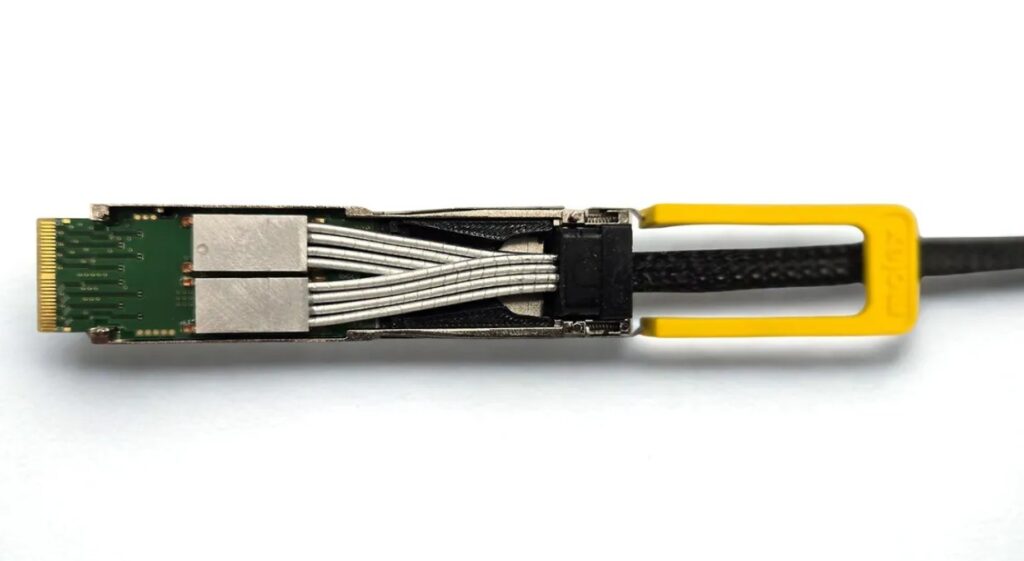
An IEEE Spectrum feature explains why traditional copper cables are reaching their limits in high-performance computing and data centers, and why technologies such as radio-frequency over fiber are emerging as promising alternatives. Data centers are pushing massive amounts of information between GPUs and servers to train advanced AI models or handle complex workloads. Copper cables work well over short distances, but at terabit-per-second scales they suffer from signal loss, require thicker conductors and more power, and can’t easily span longer distances without fancy electronics at each end. This physical limit, often called the “copper cliff,” comes from effects like skin effect, where high-frequency currents crowd into thin outer layers of the wire, increasing resistance and energy loss.
The article highlights startups such as Point2 Technology and AttoTude that are building cables and connection systems using radio waves carried over optical fibers. Optical fiber has long been used for long-haul communication because it transmits light with very low loss. But these new systems take traditional radio frequencies, convert them into light, and send them through fiber, combining the low-loss reach of optics with the simplicity and power efficiency of radio transmission. Early prototypes already promise distances up to 10–20 meters or more with much lower power draw and cost compared with optical systems, and far greater reach than copper in tough, dense server racks.
In practice, RF-over-fiber lies between copper and pure optic links. At each end of the fiber, a transceiver converts electrical data into modulated light and back again. This can replace some copper connections entirely, bringing longer reach without the complexity and expense of full photonic links.
Such technology matters not only for data centers but for wireless networks and advanced communications infrastructure. In telecommunications, RF over fiber systems are already used to distribute radio signals in 5G networks, satellite communications, and distributed antenna systems because they maintain signal integrity over long distances with minimal interference.
Engineers see this as a key part of future high-speed networking where copper can no longer keep up with bandwidth demands, offering a blend of performance, efficiency, and flexibility as systems scale to terabit-level operations.
