

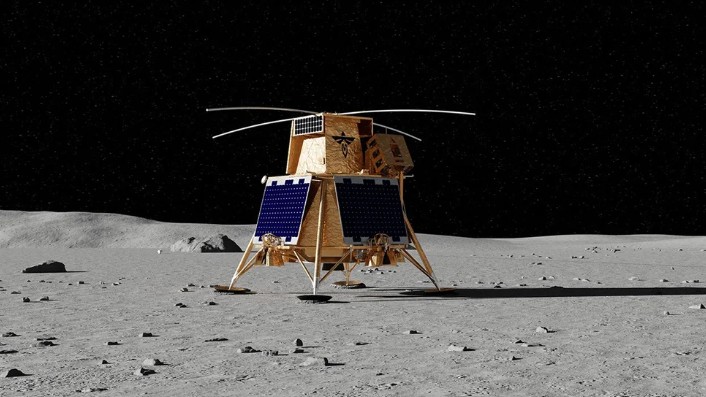
NASA and its partners are preparing to place a radio telescope on the far side of the Moon, a location uniquely suited for low-frequency astronomy because it is shielded from Earth’s radio noise and interference, tells IEEE Spectrum. The mission’s instrument, Lunar Surface Electromagnetics Experiment—Night (LuSEE-Night), is scheduled to launch in 2026 aboard Firefly Aerospace’s Blue Ghost 2 lander. Once on the lunar far side, the receiver will scan radio frequencies between about 0.1 and 50 megahertz, a range largely inaccessible from Earth due to the ionosphere and terrestrial interference. This radio-quiet environment is among the cleanest in the inner solar system, especially during the lunar night when sunlight-induced noise disappears.
LuSEE-Night’s two long dipole antennas and spectrometer will seek extremely faint cosmic signals, including those from the so-called cosmic dark ages, a period hundreds of millions of years after the Big Bang that remains poorly understood. Signals from neutral hydrogen at these low frequencies have been stretched by the universe’s expansion to wavelengths that Earth-based telescopes cannot observe. Detecting these emissions could reveal details about cosmology and the early universe that have eluded scientists so far.
The mission faces significant engineering challenges. The lunar environment’s temperature swings between blistering heat and deep cold make thermal management and power systems crucial to protecting sensitive equipment. LuSEE-Night will rely on solar charging during the lunar day and battery power to keep systems alive through long nights.
Beyond LuSEE-Night, scientists envision more ambitious lunar radio astronomy projects. Concepts such as large interferometric arrays or kilometer-scale telescopes could map the sky in unprecedented detail at frequencies below 50 MHz, potentially shedding light on dark matter, early galaxies, and exoplanet magnetospheres. Placing radio observatories on the Moon’s far side marks a new chapter in astronomy, using our nearest celestial neighbor as an observatory shield to explore the universe in frequencies otherwise lost in Earth’s noise.
