

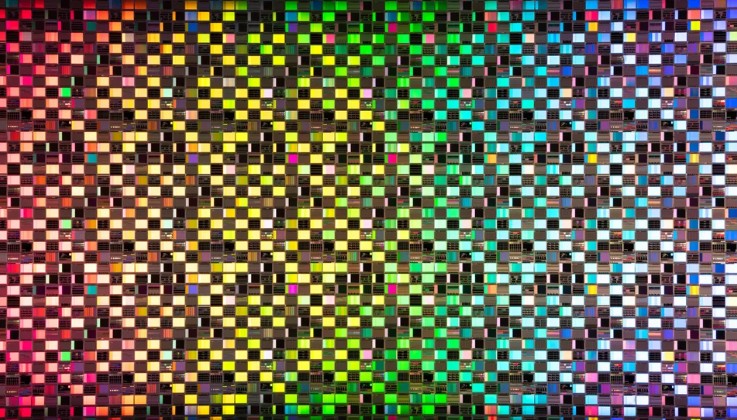
Researchers developed a compact photonic chip that converts a high-power multimode laser diode into a stable “rainbow” of discrete optical frequencies that can each carry their own data stream. What started as a project aimed at improving lidar ended in serendipity: the laser beam unexpectedly split into multiple color bands that maintained phase and frequency alignment, a characteristic of a frequency comb, tells Live Science.
The innovation relies on self-injection locking, where a small portion of the laser’s light is fed back via on-chip resonators to stabilize the beam. Once immediate stability was achieved, the beam is channeled into micro-scale waveguides that produce dozens of evenly spaced wavelengths. The outcome: a photonics device that can transmit many parallel data streams in one physical channel, replacing what previously required racks of individual lasers. This is especially relevant to data centers burdened by AI-related growth and increasing energy consumption.
Beyond data transmission, the researchers argue that the chip’s compact, efficient format could benefit spectrometers, portable quantum devices, lidar systems, and even optical clocks. They emphasize that bringing lab-grade laser performance into real-world, miniaturized form factors marks a shift in photonic engineering.
For engineers and systems designers focused on AI and high-performance computing infrastructure, this presents a notable opportunity: by drastically reducing the number of discrete lasers and improving the bandwidth per channel, this photonic approach could help lower both space and power demands. While commercial readiness remains ahead, the research underscores the potential of photonics to relieve energy bottlenecks in AI hardware.
The “rainbow-on-a-chip” isn’t just a novelty; it could become a cornerstone in next-generation AI infrastructure design.
