

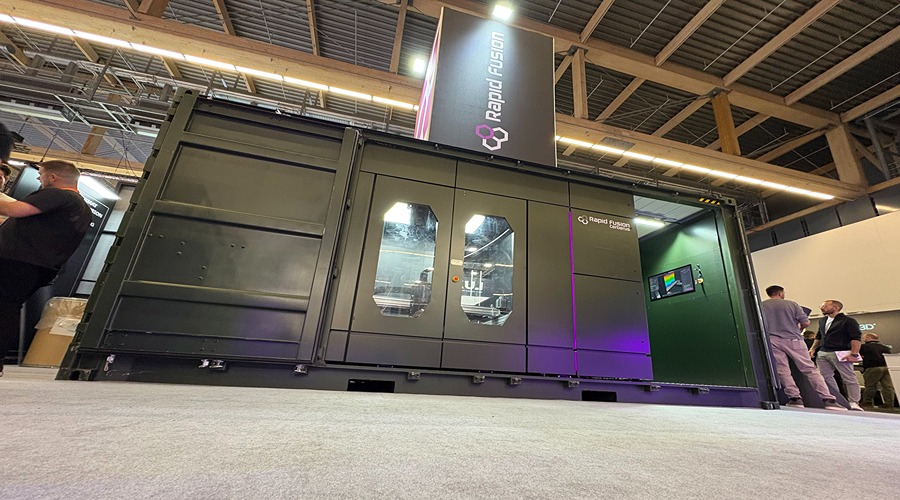
Rapid Fusion stated there is a surge in demand for its for its large-format additive manufacturing systems, including Apollo, Zeus and Medusa. New domestic and international orders have pushed company revenue beyond £2 million since launch. Rapid Fusion said it plans to use that growth to accelerate deployment of Cerberus, its containerized manufacturing system designed for use in remote and constrained locations.
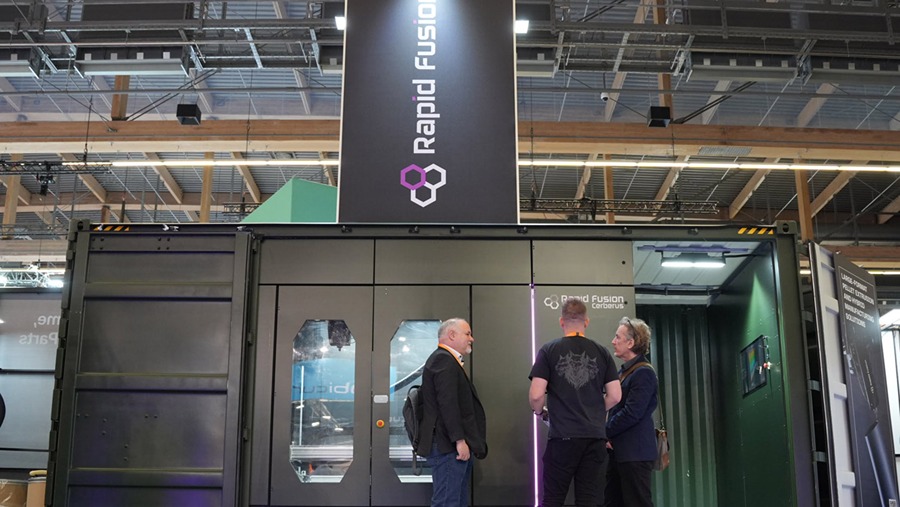
Cerberus, which debuted at Formnext in Nov’2025, is a purpose-built containerized manufacturing system designed for rapid deployment and rugged operation. It is intended for use in isolated settings, including arctic oil platforms, desert forward bases, disaster zones, and remote construction sites.
Jake Hand, founder of Rapid Fusion, commented: “There has been a lot of disruptors entering the 3D printing world and promising to print lots of one-off, unrealistic products that don’t really make commercial sense.”
“We’ve instead looked at how we build our solutions so they are 100% focused on creating usable manufacturing parts that will go into automotive, aerospace and, increasingly, into military and life-saving applications.”
He added: “That’s what has really paid off for us and helped us to grow in what has been a very challenging time. Our core robotic systems – all designed, developed and built in the UK – have enjoyed strong sales, and now Cerberus promises to be the gamechanger.”
“With our expansion plans beginning to materialize this year, we are in an immediate position to create five new engineering, design and software roles, with a further four jobs required by the end of 2026.”
Rapid Fusion provides industrial 3D printing services from its Exeter facility and is building on interest generated at Formnext. The company introduced Cerberus, a container-native hybrid manufacturing system that combines large-format 3D printing with CNC machining. Rapid Fusion said Cerberus supports a 1,200 mm³ build volume, pellet throughput up to 17kg per hour, and 3 kW of continuous spindle power for machining.
Cerberus targets remote sites where supply chain delays can stretch for months. It supports bulk materials and can run locally sourced polymers. The system uses dual independent heads and operates up to 500°C for advanced composite production. Rapid Fusion says startup needs a single 5-pin commando power socket. Cerberus includes self-leveling system for uneven ground and an automated start-up sequence for verification and calibration.
Martin Jewell, chief technical officer at Rapid Fusion, added: “We thought it was going to be popular, but the response at Formnext and what has followed has been phenomenal.”
“They fact we can deploy such a high-quality hybrid manufacturing system in just 25 minutes is unheard of and we’re currently in negotiations with several organizations keen to be among the first purchasers of this technology.”
“Parts can be made on our system for rescue drones, safety critical parts for oil and gas, vital medical equipment in disaster zones and replacement bits for vehicles operating in some of the most demanding terrains in the world.”
He concluded: “There has even been talk of creating dedicated manufacturing cells that will accelerate the scale-up and delivery of Cerberus.”
Source: Rapid Fusion
About Rapid Fusion

Rapid Fusion, established in 2023 and based in Exeter, UK, develops large-format additive manufacturing (LFAM) systems for polymer-based applications. Its product portfolio includes pellet extrusion hardware and robotic 3D printing systems such as Apollo, Medusa, and Zeus, which are designed for high-speed, high-temperature printing. These solutions are used in aerospace, automotive, construction, marine, energy, and design sectors. The company manufactures its equipment in the UK and operates a 5,000-square-foot demonstration facility at Skypark for product trials and customer engagement. The company has received support from Innovate UK to expand its product capabilities and market reach. Its technology focuses on scalable, efficient production of large polymer parts using pellet-based 3D printing integrated with industrial robotics.
