

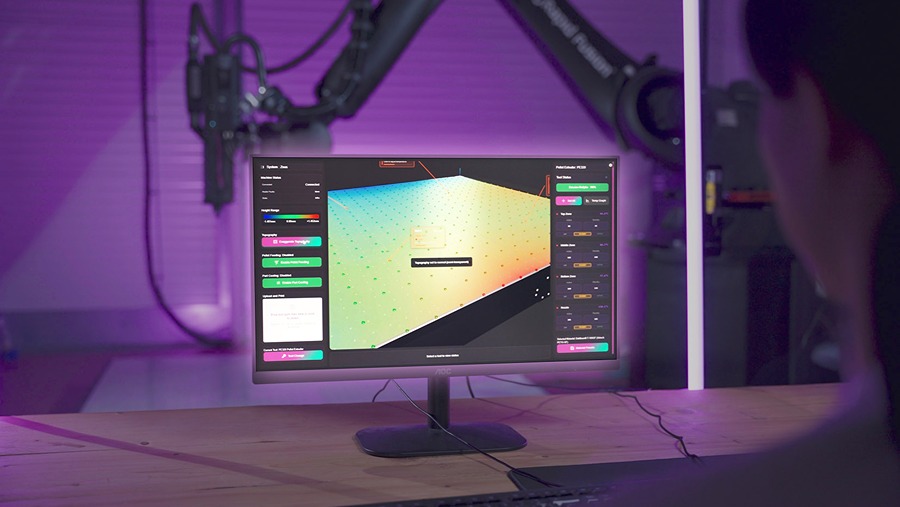
Rapid Fusion has rolled out an AI print assistant for its robotic additive manufacturing systems, designed to reduce downtime and simplify production of complex parts in aerospace, automotive, construction, medical and military sectors.
After eight months of coding, troubleshooting and various live tests, ‘Bob (Base of Build)’ is rolled out to existing clients. The system is designed to improve robot usability, increase operator control, and reduce downtime with preventive maintenance features.
The pre-loaded knowledge bank, designed to hold 3D printing expertise, operates in both secure online (cloud connected) and offline (air-gapped) setups. This approach addresses the needs of military and IP-sensitive users. The knowledge bank is compatible with Rapid Fusion’s existing systems, including Apollo, Zeus, and the newly released large-format hybrid printer, Medusa.
“There is a lot of talk about how AI can transform the business world and numerous companies are jumping on the bandwagon,” explained Martin Jewell, chief technology officer at Rapid Fusion.
“It’s something we’ve been aware of from day one and all of our robotic additive manufacturing systems have been built so that we can use artificial intelligence to unleash the full potential of our technology.”
He continued: “Having our own AI ‘print assistant’ is a gamechanger and will cut machine downtime and boost efficiency. We’re teaching our systems to understand challenges and different scenarios, which means we can make the user interface more responsive and simpler to embrace – opening it up to all the workforce.”
“In essence, if we can make our systems as ‘plug and play’ as possible it means we will have more adopters. It’s a simple as that.”
Rapid Fusion, operating from its demo center in Exeter with a team of ten, has integrated over 1,000 printing parameters into its AI model to optimize settings for more than 100 components. The system includes smart extrusion readiness, which monitors live temperatures across four heating zones using stability windows. It provides confidence-rated go/no-go decisions by analyzing heating and cooling profiles for each material against set safety thresholds.
Material aware intelligence also covers variants, including carbon fiber composites and high-temperature polymers. When users say, ‘I need to print a high-temp mold tool,’ the AI accesses profiles considering heat deflection temperatures, mold shrinkage, thermal expansion, and mechanical properties for optimal configuration.
Martin went on to add: “There’s lots more. Task completion orchestrator operates three-tier intent processing; fast pattern matching for simple commands, AI interpretation accesses comprehensive material databases for complex requests, and advanced contextual understanding ensures accurate execution across all scenarios.”
“Finally, the AI temperature command handler includes ‘smart chained’ intentions that combine multiple actions. For example, natural requests trigger automated sequences selecting appropriate materials, configuring multi-zone temperatures, evaluating post-processing requirements, and optimizing based on embedded engineering data for the specific application.”
“It’s feature rich, has a modern user interface, is completely secure and, importantly, has been built for universal integration and agent flexibility, meaning it can be shipped with either an OpenAI-powered agent or a locally hosted AI agent for online/air-gapped use.”
He concluded: “There’s a massive pre-loaded knowledge based, covering all our products, maintenance guides, troubleshooting and practical print flows. We believe we’ve produced a ‘true’ additive manufacturing knowledge bible.”
‘Bob’ will initially support two user levels. The first is a super user, such as a trusted partner or university, who can be helpful in product development. The second is a standard offering, set for release in early 2026, available to all Rapid Fusion system users. Software upgrades can be delivered remotely, enabling updates and support for customers as 3D printing technology advances.
Source: Rapid Fusion
About Rapid Fusion

Rapid Fusion Ltd, established in 2023 and based in Exeter, UK, develops large-format additive manufacturing (LFAM) systems for polymer-based applications. Its product portfolio includes pellet extrusion hardware and robotic 3D printing systems such as Apollo, Medusa, and Zeus, which are designed for high-speed, high-temperature printing. These solutions are used in aerospace, automotive, construction, marine, energy, and design sectors. The company manufactures its equipment in the UK and operates a 5,000-square-foot demonstration facility at Skypark for product trials and customer engagement. Rapid Fusion reported first-year revenue of approximately £1.7 million. The company has received support from Innovate UK and collaborates with industry partners to expand its product capabilities and market reach. Its technology focuses on scalable, efficient production of large polymer parts using pellet-based 3D printing integrated with industrial robotics.
