

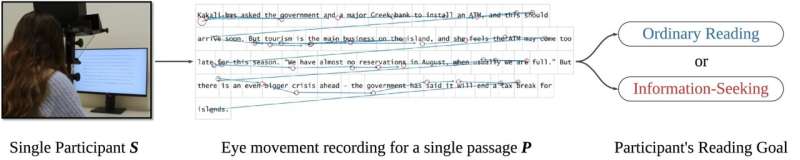
Researchers from Technion’s Faculty of Data and Decision Sciences have developed an AI-driven eye-tracking system that infers a reader’s intent—such as whether they’re reading for general comprehension or searching for specific information—with impressive accuracy. The system achieves approximately 90% accuracy, and it can correctly interpret intent in nearly 80% of cases within just two seconds of reading, says Tech Xplore.
Presented at the Association for Computational Linguistics conference in Vienna, this innovation merges detailed eye movement data—like fixations and saccades—with text analysis via computational models. The result: real-time insight into a reader’s purpose without relying on explicit input.
Dr. Yevgeni Berzak, who leads the Language, Computation, and Cognition Lab at Technion, describes this as part of a broader AI initiative. The team aims to infer, purely from eye movement, aspects such as a reader’s linguistic proficiency, reading habits (e.g., first vs. second pass), text readability, and even the specific information sought.
As eye-tracking capabilities become more widespread and accessible—now included in mainstream devices like smartphones and tablets—the researchers see vast potential for real-world deployment. Applications span educational tools, personalized content delivery, enhanced accessibility for diverse users, and smarter digital experiences across government, media, and beyond.
