

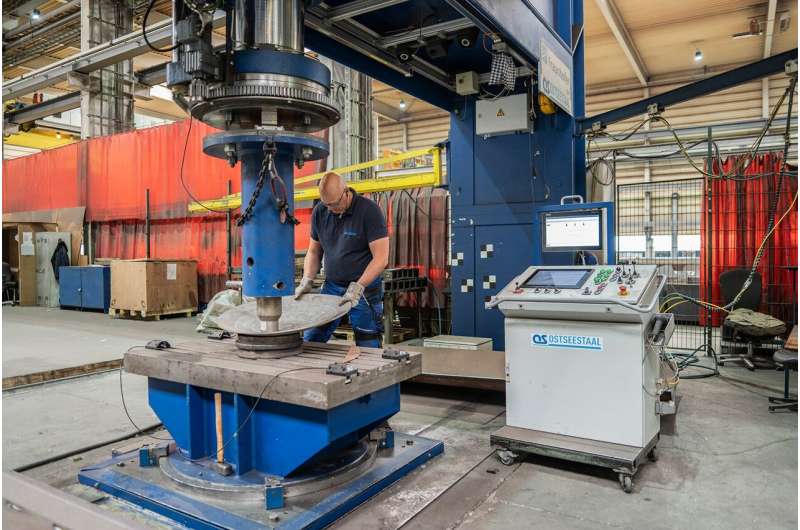
Researchers participating in the digitalization of cold plastic forming through continuous quality control (DIKUQ) project have developed a real-time three-dimensional measurement system that promises to streamline steel forming for shipbuilding and cut reliance on manual inspection, tells Tech Xplore. The innovation targets a longstanding bottleneck in shipyard production, where large steel sheets intended for hulls and other structural components must be bent and shaped with millimeter-level accuracy. Traditionally, workers depend on experience and intermittent manual checks with physical templates, stopping production frequently to verify geometry and make adjustments. This process is time-consuming, highly dependent on specialist skill, and prone to variability.
The new system, designed by the Fraunhofer Institute for Applied Optics and Precision Engineering IOF alongside partners in the DIKUQ project, integrates high-speed inline 3D scanning directly at the forming press. A network of synchronized cameras and projectors captures the three-dimensional shape of a workpiece in less than half a second. Using near-infrared structured light and triangulation, the system reconstructs precise 3D models of steel sheets up to several meters in size. This allows operators to compare actual geometry with digital target models instantly and spot deviations in real time, without stopping the press or relying on physical templates.
Immediate digital feedback enables workers to pinpoint exactly where rework is needed, thereby minimizing quality fluctuations that previously stemmed from subjective judgment. The approach also creates a traceable quality record for customers and makes complex shaping tasks easier to teach to new workers, addressing skilled labor shortages in shipyards. Once fully integrated, this digitally networked process chain, from incoming inspection through forming and final quality checks, could reduce rework, shorten production cycles, and improve the overall accuracy of fabricated components. Project partners note that the concept has potential applications beyond shipbuilding in sectors such as aerospace and architecture, where large, custom steel parts require precise forming.
