

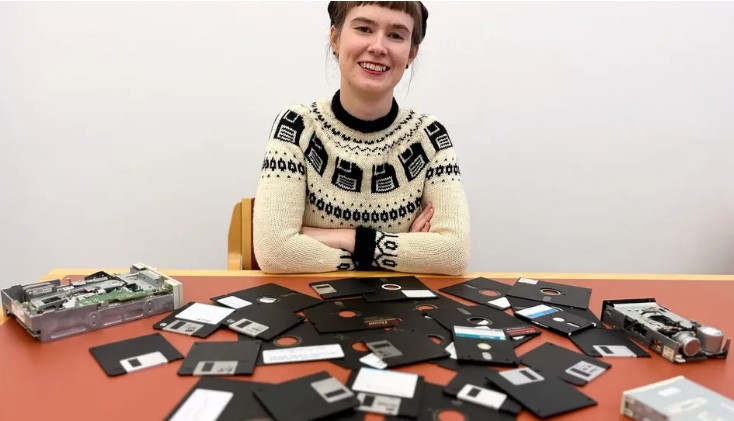
Cambridge University Library has introduced Future Nostalgia, an ambitious digital preservation effort aimed at recovering data trapped on obsolete floppy disks before magnetic decay erases them entirely. The program kicked off with a “Copy that Floppy” event on October 9, where the public was invited to bring in their old disks and enlist archivists to explore what lies inside them, tells Tom’s Hardware.
The library already holds over 150 floppy disks in its collections, including some from the Stephen Hawking archive, i.e., documents, software code, and early drafts, that may otherwise vanish with time. The urgency is clear: magnetic media degrade, floppy drives become scarce, and many proprietary file formats risk being unreadable before they’re properly archived.
To tackle the technical challenges, the preservation team is relying on flux imaging techniques using devices such as KryoFlux and Greaseweazle. Rather than simply reading files, these tools capture the raw magnetic transitions on the disk surface. This approach can recover data from nonstandard formats, damaged sectors, or disks beyond the reach of typical floppy drives. They work at the lowest level of data encoding, reconstructing files even when traditional reading fails.
Yet recovery is only half the battle. Once data is extracted, archivists must translate obsolete or proprietary formats into modern equivalents so information remains usable. Future Nostalgia plans to document flexible workflows for disk handling, imaging, decoding, and format translation, making them shareable across libraries and archives. The project also draws on support from the retrocomputing community, whose expertise in working with archival hardware and esoteric formats is proving invaluable.
Future Nostalgia is more than nostalgia: it’s a defense against digital extinction. By marrying specialized hardware, expertise, and public engagement, Cambridge aims to save personal, academic, and historical data before it’s lost forever.
