

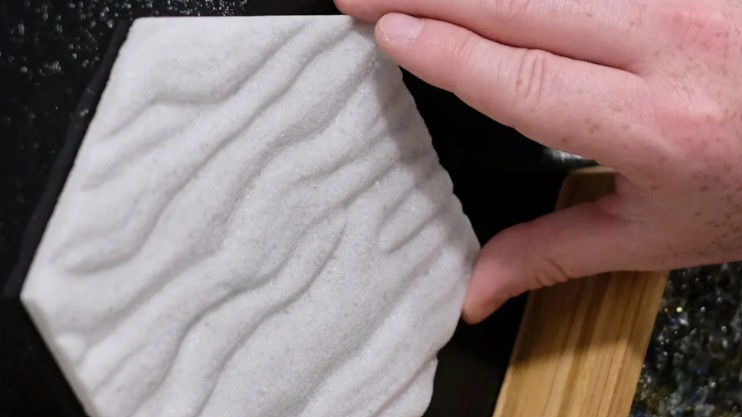
A new additive manufacturing process developed by startup Glassomer is pushing recycled glass into the expanding world of industrial 3D printing. A recent report from Tom’s Hardware examines how the company is using binder-jet technology to create printable glass components from recycled materials, potentially opening new paths for sustainable manufacturing.
Glass has traditionally posed major challenges for additive manufacturing because of its high melting temperatures, brittleness, and sensitivity to thermal stress. Existing glass-printing methods often require specialized equipment and energy-intensive heating systems. Glassomer’s approach instead relies on a binder-jet process that deposits layers of powdered recycled glass combined with a liquid binding agent, creating complex forms without directly melting the material during printing.
Once the printed object is formed, it undergoes post-processing steps including debinding and sintering, which remove the adhesive material and fuse the glass particles into dense solid structures. According to the article, the process can produce transparent or translucent objects with intricate geometries that would be difficult or impossible to manufacture using traditional glassworking techniques.
The company positions the technology as both a sustainability initiative and a manufacturing innovation. Recycled glass is widely available, yet much of it remains difficult to reuse economically because contamination and sorting challenges limit conventional recycling pathways. By converting waste glass into printable feedstock, the process could reduce landfill disposal while lowering demand for virgin raw materials.
The article highlights potential applications across architecture, optics, scientific equipment, and industrial design. Binder-jet fabrication enables customized internal channels, lightweight lattice structures, and geometries tailored for specific optical or thermal properties. Such flexibility could prove valuable for laboratories, lighting systems, and high-end architectural components where customization is increasingly important.
Glassomer’s work also reflects a broader shift occurring within additive manufacturing. Researchers and startups are moving beyond plastics and metals to develop printable processes for ceramics, composites, biological materials, and advanced glasses. These efforts aim to expand 3D printing from prototyping into mainstream production technologies capable of handling more diverse industrial materials.
The article suggests that recycled-glass printing could become especially relevant as manufacturers face growing pressure to reduce waste and carbon emissions. While the technology is still emerging, it demonstrates how additive manufacturing is increasingly intersecting with circular-economy strategies and sustainable materials engineering.
