

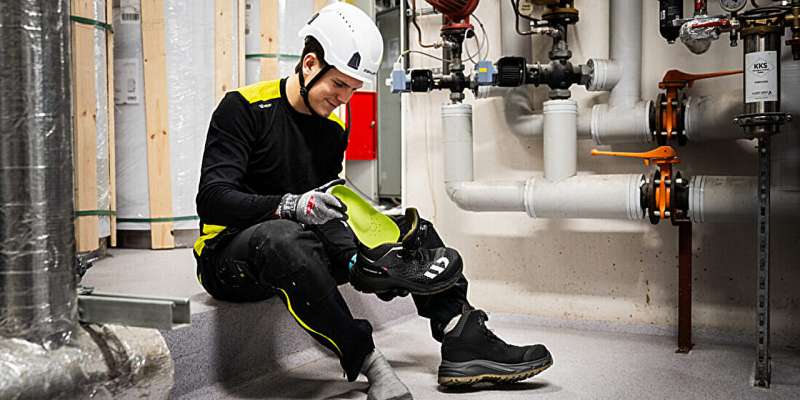
Workers in construction, manufacturing, offshore operations, and other industrial settings depend on protective footwear to guard against impacts, punctures, and other workplace hazards. However, traditional safety shoes often sacrifice comfort and ergonomics in favor of protection, contributing to musculoskeletal problems among people who spend long hours walking, standing, or kneeling on hard surfaces. Researchers at SINTEF have developed a new safety shoe concept called Lightfoot that aims to address this longstanding challenge, tells Tech Xplore.
The project introduces a fundamentally different approach to footwear design. Conventional safety shoes typically incorporate nail protection above a foam midsole, a configuration that can reduce cushioning and comfort. The Lightfoot team reversed this arrangement by placing the nail protection at the bottom of the shoe and creating an empty shell that accommodates replaceable midsoles. These midsoles are significantly thicker than traditional insoles and are available in different firmness levels, allowing users to select options based on their body weight, work environment, and personal preferences.
This design places cushioning materials closer to the foot, resulting in improved shock absorption and stability. Laboratory testing involving approximately 20,000 measurements demonstrated that the new footwear reduced heel forces by more than 6% compared with existing safety shoe models. While that figure may appear modest, it translates into a substantial reduction in cumulative impact for workers who take between 10,000 and 20,000 steps during a typical workday.
Field trials involving workers in offshore and land-based industries produced similarly positive feedback, with participants reporting greater comfort and less joint discomfort. Although researchers caution that long-term studies are still needed to establish direct links between footwear and reduced musculoskeletal disorders, the early results are promising.
The project also achieved a 52% reduction in manufacturing-related climate impact by replacing leather in the shoe upper and redesigning production methods. Developed through collaboration among experts in physiology, biomechanics, industrial design, data analysis, and industry partners, Lightfoot demonstrates how interdisciplinary engineering can improve worker safety, health, comfort, and sustainability simultaneously.
