

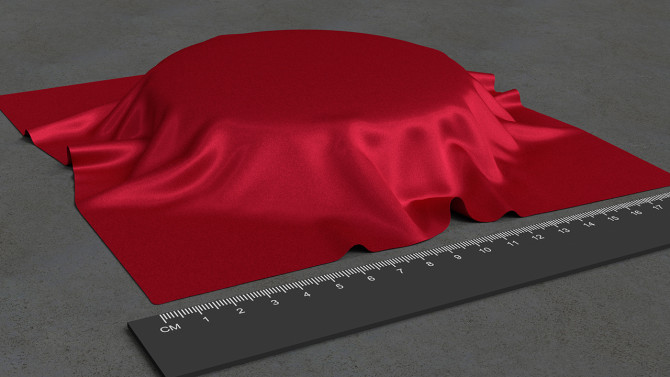
Digital fabric has long challenged computer graphics because fine yarn structures interact with light in complex ways, making cloth look unrealistic in renders. Researchers at Cornell University, working with Nvidia, have unveiled a new method that significantly improves the realism of rendered textiles by modeling both the microscopic structure of fibers and the physics of light at multiple scales, tells Cornell Chronicle. The work was presented at SIGGRAPH Asia 2025 in Hong Kong and builds on decades of research into material appearance and light interaction.
Fabric isn’t a smooth, continuous surface such as metal or skin. It’s made of fiber strands called plies that twist into yarn and then weave or knit into cloth. Each fiber’s shape, nearly oval in wool, kidney-shaped in cotton, and polygonal in silk, influences how light reflects and transmits through the fabric. Cornell’s new technique accounts for these differences by simulating how light rays bounce off fibers and how light waves bend and diffract through gaps at the micro level. Using both ray and wave optics produces highlights, sheens, and translucence that closely match physical textiles.
Early attempts to use wave optics alone proved too computationally heavy, so the team optimized performance by combining fast ray-based calculations for average surface color and main highlights with selective wave-based computation for subtle glints and transmitted light effects. This hybrid approach yields detailed, convincing images without prohibitive processing costs.
The researchers plan to integrate artificial intelligence to further accelerate the process, allowing models to predict lighting effects without running full simulations. That could open the door to real-time or near-real-time fabric rendering for video games, design visualization, and animation.
Lead scientists see this as a step toward a practical, general-purpose fabric model that captures a wide range of textile types, from satin and silk to knits and heavy twills, giving digital artists and designers tools that better represent real-world materials under varied lighting conditions.
