

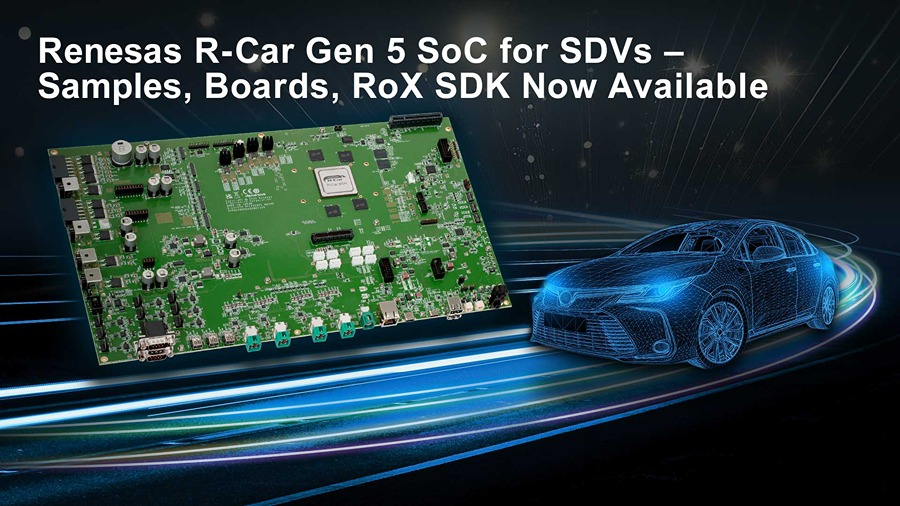
TOKYO, Japan, Dec 17, 2025 – Renesas Electronics has expanded its software-defined vehicle (SDV) solution offerings and introduced the R-Car X5H, a 3 nm automotive system-on-chip (SoC). The chip can run multiple vehicle workloads at the same time. These include advanced driver assistance systems (ADAS), in-vehicle infotainment and gateway functions.
Renesas has started sampling Gen 5 silicon. It provides evaluation boards and the R-Car Open Access (RoX) Whitebox software development kit (SDK) for the next development phase. Renesas is also collaborating with customers and partners to support adoption. At CES 2026, the company plans to demonstrate AI-powered, multi-domain use cases running on the R-Car X5H.
The R-Car X5H uses an advanced process node to combine compute, power and integration. Renesas said it reduces power use by up to 35% compared with 5 nm solutions. The SoC is designed to serve multiple SDVs with central compute. It targets AI workloads and supports scaling performance using chiplet extensions. Chiplets are add-on dies that expand processing capability. Renesas said the device delivers up to 400 TOPS of AI performance. With chiplets, it said acceleration can increase by four times or more. It also features 4 TFLOPS equivalent* of GPU power for high-end graphics and over 1,000k DMIPS powered by 32 Arm Cortex-A720AE CPU cores and six Cortex-R52 lockstep cores with ASIL D support. Leveraging mixed technology, the SoC executes advanced features in multiple domains without compromising safety.
Renesas is expanding the RoX development platform to support hardware-software integration for complex E/E architectures. RoX aims to simplify development by combining hardware, operating systems, software and tools to speed vehicle development and support software updates.
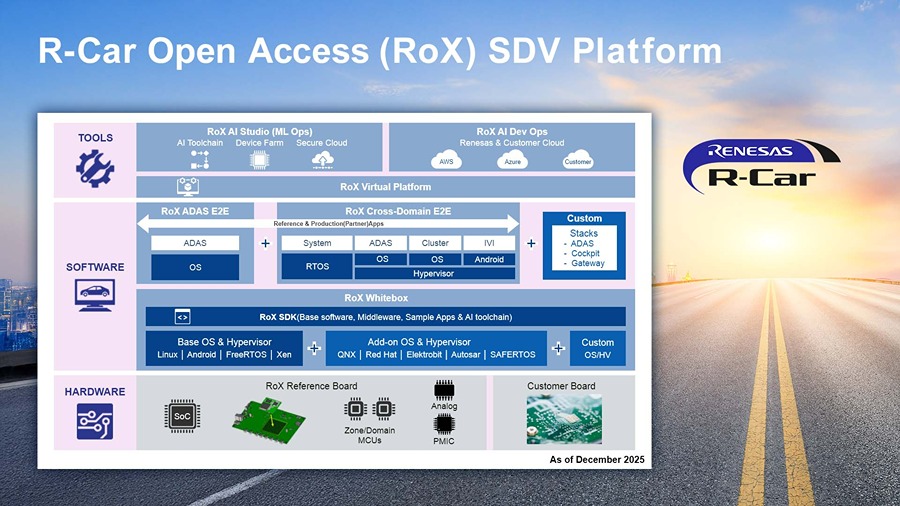
Accelerating Automotive Innovation with an Open, Scalable RoX Whitebox SDK
Renesas offers the RoX Whitebox software development kit (SDK) for the R-Car X5H. The kit is an open platform built on Linux, Android and the XEN hypervisor. The kit also supports partner operating systems and software, including AUTOSAR, EB corbos Linux, QNX, Red Hat and SafeRTOS. The company said developers can use the kit to start ADAS work. It also targets L3/L4 automated driving, intelligent cockpits and gateway systems. Renesas said its AI and ADAS software stack supports real-time perception and sensor fusion. Perception uses sensors to detect objects and road conditions. Sensor fusion combines inputs from multiple sensors into one view. Renesas also said generative AI and large language models (LLMs) can support human-machine interaction in AI cockpits. The SDK integrates partner application stacks from Candera, DSP Concepts, Nullmax, Smart Eye, STRADVISION and ThunderSoft.
“Since introducing our most advanced R-Car device last year, we have been steadfast in developing market-ready solutions, including delivering silicon samples to customers earlier this year,” Vivek Bhan, senior vice president and general manager of high performance computing at Renesas. “In collaboration with OEMs, Tier-1s and partners, we are rapidly rolling out a complete development system that powers the next generation of software-defined vehicles. These intelligent compute platforms deliver a smarter, safer and more connected driving experience and are built to scale with future AI mobility demands.”
“Integrating Renesas’ R-Car X5 generation series into our high-performance compute portfolio is a natural next step that builds on our existing collaboration,” said Christian Koepp, senior vice president compute performance at Bosch’s cross-domain computing solutions division. “At CES 2026, we look forward to showcasing this powerful solution with Renesas X5H SoC, demonstrating its fusion capabilities across multiple vehicle domains, including video perception for advanced driver assistance systems.”
“Innovative system-on-chip technology, such as Renesas’ R-Car X5H, is paving the way for ZF’s software-defined vehicle strategy,” said Dr. Christian Brenneke, head of ZF’s electronics & ADAS division. “Combining Renesas’ R-Car X5H with our ADAS software solutions enables us to offer full-stack ADAS capabilities with high computing power and scalability. The joint platform combines radar localization and HD mapping to provide accurate perception and positioning for reliable ADAS performance. At CES 2026, we’ll showcase our joint ADAS solution.”
First Fusion Demo on R-Car X5H with Partner Solutions at CES 2026
Renesas plans invitation-only CES 2026 demos of its R-Car X5H. The multi-domain setup runs on the RoX platform and upgrades from R-Car Gen 4 hardware. It combines ADAS and IVI stacks with an RTOS and edge AI functionality. The software runs on Linux and Android with Xen hypervisor virtualization. The demo supports eight high-resolution camera inputs and up to eight displays, with resolutions reaching up to 8K2K. Renesas said the platform, paired with the RoX Whitebox SDK and partner software stacks, targets real-world use across multiple vehicle domains.
Availability
Renesas is shipping R-Car X5H silicon samples and evaluation boards, along with the RoX Whitebox SDK, to select customers and partners.
*1 Equivalent TFLOPS based on data from Manhattan 3.1 industry benchmarks.
Source: Renesas Electronics
About Renesas Electronics

Renesas Electronics, based in Tokyo, supplies power management integrated circuits (PMICs) and ships more than 1.5 billion power devices annually for computing, industrial, IoT, data center, and communications markets. Its portfolio includes PMICs, discrete devices, GaN power products, and design tools such as PowerCompass and PowerNavigator. These work with microcontrollers, SoCs, and connectivity solutions to support system design. The company was formed in 2010 through the merger of Renesas Technology and NEC Electronics, with origins in semiconductor units of Hitachi, Mitsubishi, and NEC.
