

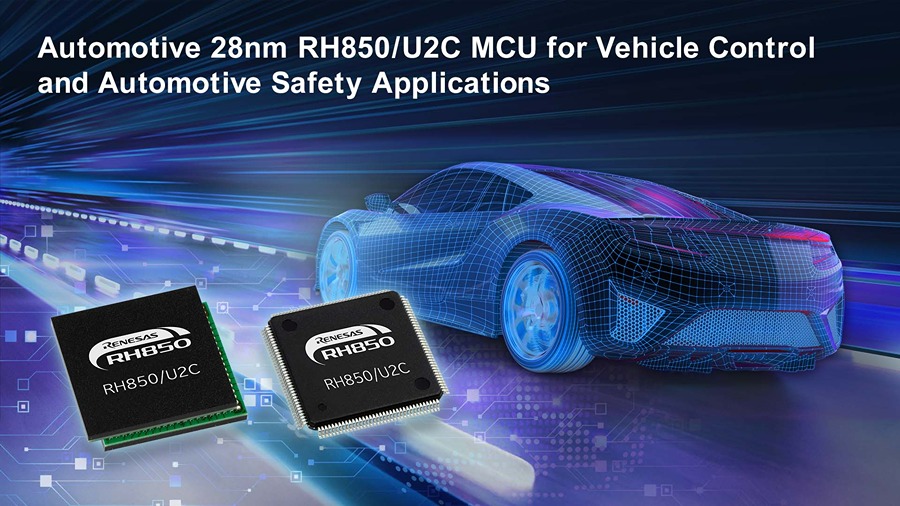
TOKYO, Japan, Mar 5, 2026 – Renesas Electronics has introduced the RH850/U2C, a 32-bit automotive microcontroller (MCU) built on a 28nm process for safety-critical vehicle systems. The MCU targets chassis and safety systems in automotives, along with battery management systems (BMS) and body control functions such as lighting and motor control. With communication interface support and integrated security, the device supports automotive applications that require ASIL D functional safety.
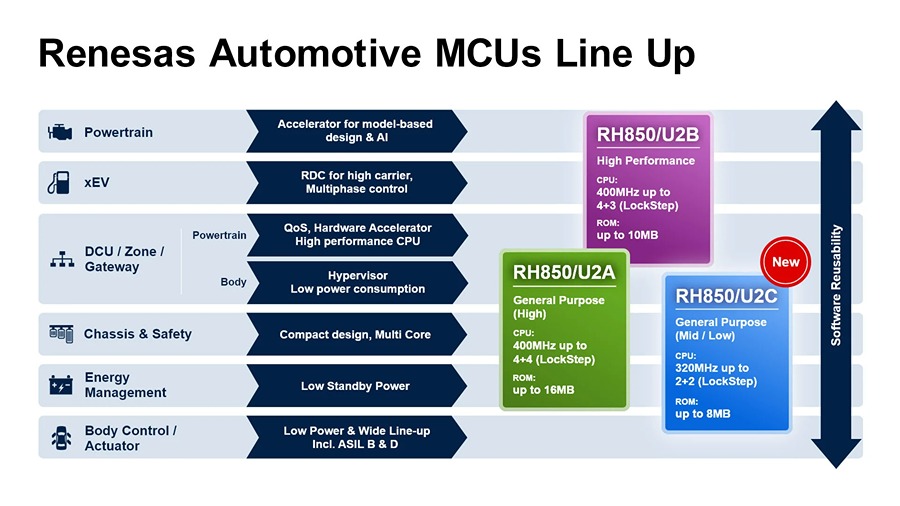
The RH850/U2C extends RH850 line-up as a lower-end option alongside the RH850/U2B and RH850/U2A devices. The RH850/U2C combines four RH850 CPU cores operating at up to 320 MHz (including two lockstep cores), with up to 8 MB of flash memory. The device also allows developers using RH850/P1x or RH850/F1x MCUs to transition to the new MCU as automotive systems adopt newer E/E architectures.
Communication Interfaces for Today’s and Next-Generation Systems
The RH850/U2C supports vehicle network interfaces used in newer E/E architectures, including Ethernet 10base-T1S, Ethernet TSN, CAN-XL, and I3C. It also remains compatible with CAN-FD, LIN, UART, CXPI, I²C, I²S, and PSI5 used in existing ECUs. These interfaces support mixed operation between new and existing electronic control units. As vehicle networks move toward domain and zone-based E/E architectures, the MCU supports flexible system configuration and scalable network design.
Robust Functional Safety and Cybersecurity Features
The RH850/U2C supports functional safety up to ASIL D under the ISO 26262 standard. For cybersecurity, the device complies with ISO/SAE 21434 and supports cryptographic algorithms, including post-quantum cryptography (PQC) and those required by Chinese and other international regulations. Dedicated hardware accelerators handle cryptographic processing and reduce CPU workload.
Power-Optimized MCU Architecture
The RH850/U2C uses a 28 nm manufacturing process and operates with reduced power consumption in active and standby modes. A dedicated standby mode reduces power use during deep stop and intermittent operation. These power modes increase power design margins and reduce thermal requirements, helping systems meet environmental regulations.
“With modern ECUs constantly evolving through software updates and new features, it’s essential that system robustness and operational efficiency co-exist seamlessly,” said Satoshi Yoshida, vice president of the High-Performance Computing MCU division at Renesas.
“The RH850/U2C combines performance, a rich feature set, and compliance with key industry standards to meet the requirements of next-generation ECUs. This is exactly the kind of platform our customers are looking for to build reliable and scalable automotive systems.”
“Renesas’ RH850 MCU family has long supported our systems with proven reliability, and we’re pleased to see the addition of the RH850/U2C further strengthen its automotive lineup,” said Christoph Wenger, chief expert semiconductor at Vehicle Motion at Bosch. “The 28nm MCUs from Renesas offer strong performance and quality, and we look forward to continuing our collaboration.”
Full Development Support
Renesas supports the RH850/U2C with a development environment that includes compilers, IDEs, and software packages for automotive use. The tools support functional safety requirements under ISO 26262 up to ASIL D. Renesas also provides a RH850/U2C starter kit for development projects.
The company plans to demonstrate the RH850/U2C at embedded world 2026 at booth 1-234 (Hall 1, Stand 234).
Source: Renesas Electronics
About Renesas Electronics

Renesas Electronics, based in Tokyo, supplies power management integrated circuits (PMICs) and ships more than 1.5 billion power devices annually for computing, industrial, IoT, data center, and communications markets. Its portfolio includes PMICs, discrete devices, GaN power products, and design tools such as PowerCompass and PowerNavigator. These work with microcontrollers, SoCs, and connectivity solutions to support system design. The company was formed in 2010 through the merger of Renesas Technology and NEC Electronics, with origins in semiconductor units of Hitachi, Mitsubishi, and NEC.
