

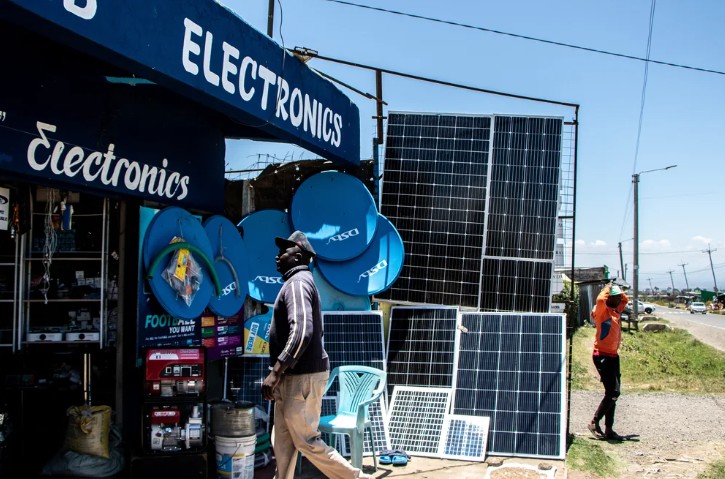
An electronics shop in Kenya sells solar panels. Off-grid solar has been a big part of the country’s successful push to increase electricity access (source: James Wakibia/SOPA Images/LightRocket/Getty Images).
Despite advances in power generation, much of sub-Saharan Africa remains in darkness: electrification rates in countries such as Chad and the Central African Republic hover below 5%, and even populous nations such as Angola and Mozambique have less than half their populations connected to the grid. Expanding traditional centralized grids is costly, slow, and often unreliable—especially in remote rural regions, reports IEEE Spectrum.
Renewable energy offers a complementary and scalable path forward. Solar power—and particularly off-grid and mini-grid solar systems—holds enormous potential for rapid deployment. Africa boasts the world’s best solar resources, with almost 60% of the planet’s prime solar terrain, translating into many terawatts of potential generation. Off-grid solar paired with storage enables communities to bootstrap electricity access, bypassing the need for costly transmission lines.
Hydropower is already a significant renewable source in certain regions. Countries such as Kenya and Ethiopia derive substantial electricity from hydro resources, though expanding capacity faces constraints such as high infrastructure costs and weather variability. Meanwhile, geothermal and wind energy are growing, especially in areas such as Kenya’s Lake Turkana wind farm and Ethiopia’s Rift Valley geothermal sites.
The scale of the challenge is immense: achieving universal access will require investments in the hundreds of billions of dollars—far surpassing current levels. Yet recent initiatives show promise. World Bank and development partners aim to reach 300 million more Africans with electricity by 2030—with distributed renewables playing a central role. Despite this, renewables still receive a tiny fraction of energy investment in Africa, highlighting the urgent need for funding reforms.
Renewables—especially solar mini-grids, hydropower, wind, and geothermal—are not just part of the solution but central to electrifying Africa in a cost-effective, sustainable, and scalable way.
