

The concept of the humanoid robot is undergoing a quiet but significant transformation. The article from Machine Design explores how evolving design priorities are challenging traditional assumptions about what a humanoid robot should look like and how it should function.
Historically, humanoid robots were defined by their resemblance to the human body, with two legs, two arms, and a head. This form factor was seen as essential for navigating environments built for humans. However, recent developments suggest that strict adherence to human-like structure may not always be the most effective or practical approach.
Advances in motion control and actuation have made robots increasingly fluid and capable, enabling them to perform complex tasks such as manufacturing assembly and even surgical assistance. At the same time, companies are experimenting with alternative designs that prioritize efficiency, cost, and task-specific performance over human mimicry.
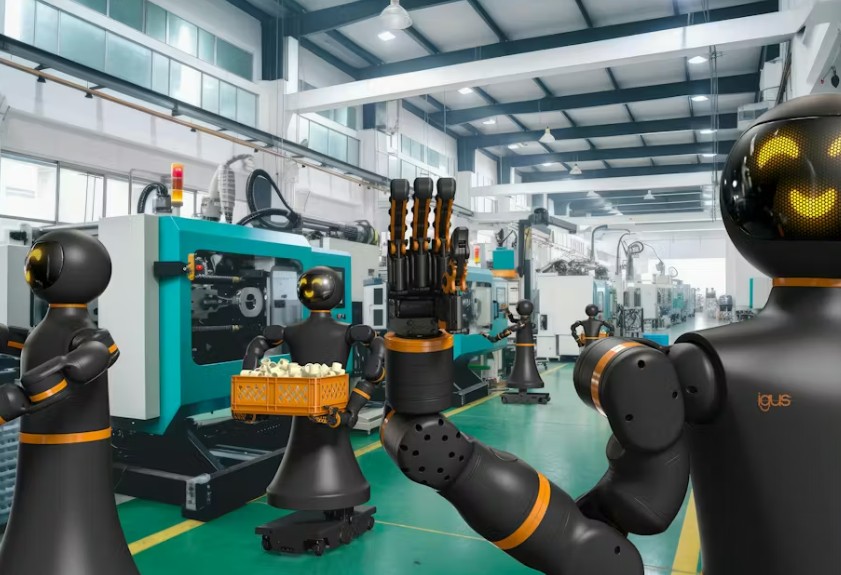
A key driver of this shift is accessibility. Traditional humanoid robots are often expensive and complex, limiting their use to large enterprises or research institutions. Newer platforms, such as igus’ low-cost systems, aim to democratize robotics by using lightweight materials, modular components, and simplified architectures. These designs make it easier for small- and medium-sized businesses to adopt automation without significant capital investment.
The article also highlights the growing importance of modularity. Instead of building fully anthropomorphic robots, engineers are creating flexible systems that can be configured for specific applications. This approach allows developers to combine components as needed, achieving functionality without unnecessary complexity.
As a result, the definition of “humanoid” is becoming more fluid. Rather than focusing solely on appearance, designers are emphasizing capability, adaptability, and cost-effectiveness. In many cases, partial or hybrid designs may deliver better results than fully human-like forms.
The broader implication is a shift in robotics philosophy. The future may not belong to machines that look exactly like humans, but to systems that capture the essence of human interaction while optimizing for real-world performance. This evolving perspective is redefining both the purpose and the design of humanoid robots across industries.
