

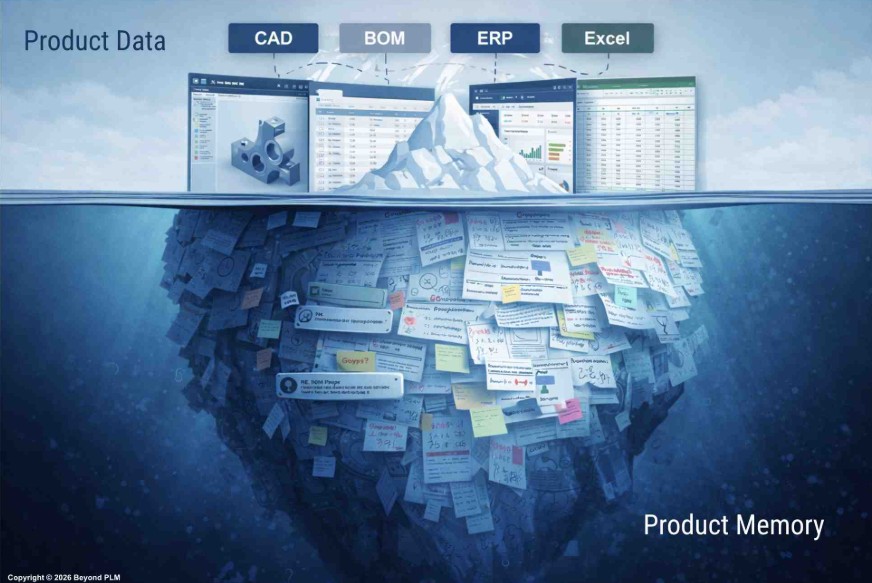
The long-standing idea of a “single source of truth” (SSOT) in product lifecycle management was never a final solution, but rather a transitional phase in the evolution of engineering data systems. The article from Beyond PLM argues that the industry focused on the wrong objective: consolidating data instead of understanding it.
SSOT was built on a clean assumption that a product could be represented by a single, unified structure. In practice, products exist in multiple parallel forms across engineering, manufacturing, and supply chain systems. These perspectives are not inconsistencies but necessary representations of how organizations operate. Attempts to force them into one structure created friction rather than clarity.
Even when companies succeeded in organizing and connecting data, a deeper limitation remained. PLM systems capture outcomes, such as revisions, approvals, and configurations, but fail to preserve the reasoning behind decisions. Critical context, including trade-offs, constraints, and informal discussions, is often lost over time. This creates gaps in knowledge, making it difficult to understand why a product evolved in a particular way.
The industry’s shift toward the “digital thread” attempted to solve this by linking systems and enabling data flow across the lifecycle. While this improved visibility and reduced silos, it still focused on connecting data rather than capturing meaning. A connected system can show what changed but not the logic behind those changes.
The article points to a new direction: moving from a “single source of truth” to a “single source of change,” where decision points are controlled even if data remains distributed. Beyond that lies the concept of “product memory,” a layer that captures the history of decisions, discussions, and context throughout the lifecycle.
This shift reflects a broader transformation from data management to knowledge management. The future of PLM will depend less on centralizing information and more on preserving intent, enabling organizations to retain institutional knowledge and make better decisions over time.
