

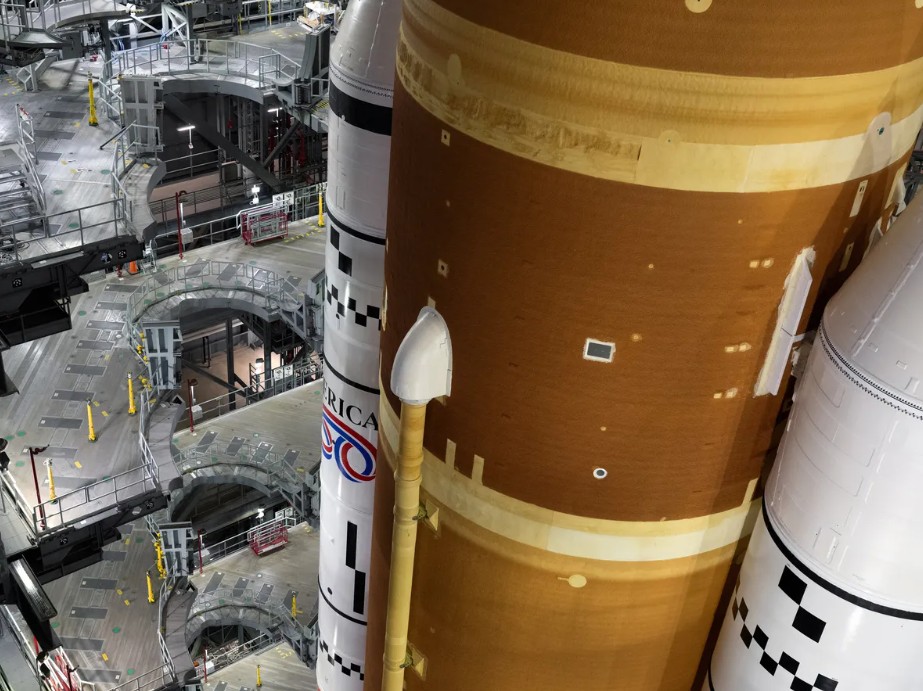
NASA’s Artemis II will carry four astronauts aboard an Orion spacecraft around the Moon, marking humanity’s first crewed lunar mission in more than half a century. The mission uses NASA’s heavy-lift Space Launch System (SLS) rocket to launch the crew on a roughly 10-day journey that loops past the Moon and back to Earth. Artemis II follows the uncrewed Artemis I flight and is a critical test of deep space systems before astronauts return to the lunar surface under Artemis III, says IEEE Spectrum.
The Artemis II crew comprises NASA astronauts Reid Wiseman, Victor Glover, and Christina Koch, along with Jeremy Hansen of the Canadian Space Agency. These four will be the first humans beyond low Earth orbit since Apollo 17 in 1972. The mission has shifted target launch windows, most recently toward March 2026, as NASA works through preparation milestones.
Orion’s design blends legacy and modern technology. Its spacecraft systems borrow from Apollo, the shuttle era, and International Space Station programs while adding contemporary avionics and navigation systems. Orion’s crew module, with about 9 cubic meters of habitable space, carries life support, avionics, and guidance systems managed by redundant computers. A European Service Module supplied by the European Space Agency provides propulsion, power, and consumables for the mission.
The flight profile has Orion entering a series of Earth orbits before heading toward the Moon on a free-return trajectory. This path uses lunar and Earth gravity to help guide the spacecraft back home with minimal course corrections. Astronauts will spend less than two hours manually flying Orion; most operations are controlled by sophisticated guidance computers.
Artemis II is also taking on emerging communications tech. Optical and traditional radio systems are being prepared to transmit mission data, images, and crew communications across the vast distances of deep space.
Success on Artemis II is essential to clearing the way for Artemis III, which aims to land astronauts near the Moon’s south pole and begin long-term exploration of lunar terrain.
