

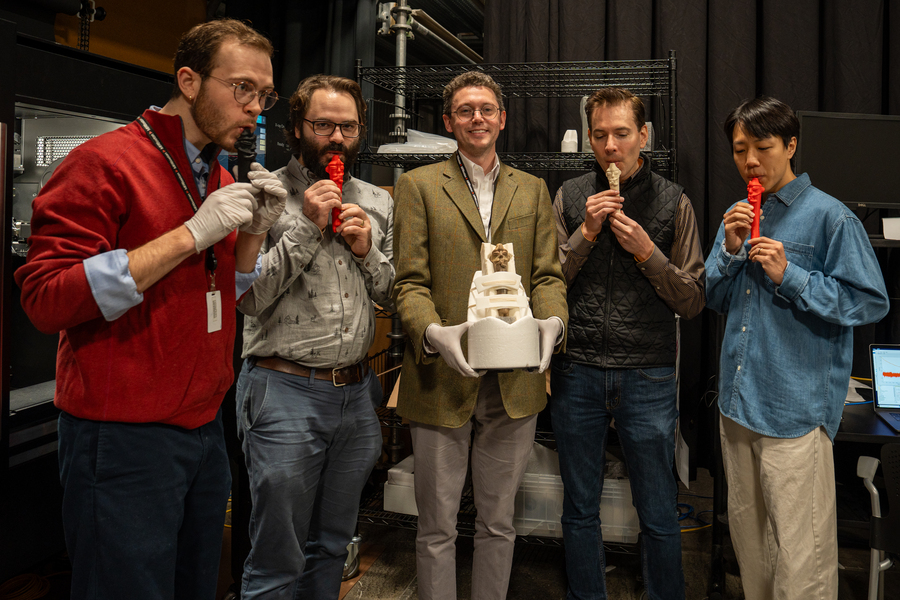
Researchers at the Massachusetts Institute of Technology are developing a new method to recreate the physical form and sound of historical musical instruments preserved in museums, tells MIT News. The interdisciplinary effort brings together engineers, archaeologists, and music technologists working with the Museum of Fine Arts, Boston, to study fragile instruments that cannot be played directly. Their goal is to reconstruct these artifacts as playable replicas so researchers and musicians can hear the sounds that once defined past musical cultures.
Many historical instruments in museum collections are too delicate to handle or perform on. While they reveal craftsmanship and visual design, their acoustic properties often remain unknown. To address this limitation, the MIT team uses advanced imaging tools such as CT scanning to examine the internal structures of instruments without damaging them. These scans reveal hidden details including internal chambers, material composition, and manufacturing techniques used centuries ago.
The digital data generated from CT imaging is then processed using specialized visualization software. Researchers analyze the geometry and internal airflow pathways that influence sound production. From these detailed models, the team can build precise digital reconstructions and physical replicas using modern fabrication technologies such as 3D printing. These replicas allow musicians to test and perform with instruments that closely replicate the originals.
One example studied by the team is an ancient whistle from the Paracas culture of Peru. By scanning and reconstructing the instrument, researchers gained insights into its complex internal design and acoustic behavior. Recreating such instruments offers a way to understand not only their construction but also the cultural and musical practices that surrounded them.
The project demonstrates the growing role of engineering tools in cultural heritage research. By combining imaging technology, digital modeling, and acoustics, scientists can reconstruct sounds that have been silent for centuries. The approach opens new opportunities for museums, historians, and musicians to explore historical soundscapes and bring ancient music back into the modern world.
