
HOUSTON, TX, Aug 21, 2025 – Materials scientists at Rice University have developed a method to grow ultrathin semiconductors onto electronic components, simplifying how two-dimensional materials are integrated into next-generation electronics and neuromorphic computing devices. Their findings in a study published in ACS Applied Electronic Materials.
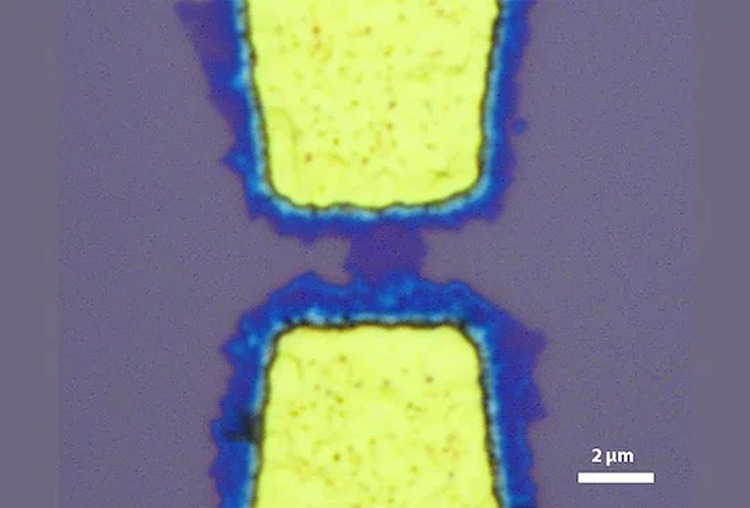
The researchers used chemical vapor deposition (CVD) to grow tungsten diselenide, a 2D semiconductor, directly onto patterned gold electrodes. They then built a transistor to demonstrate the process.
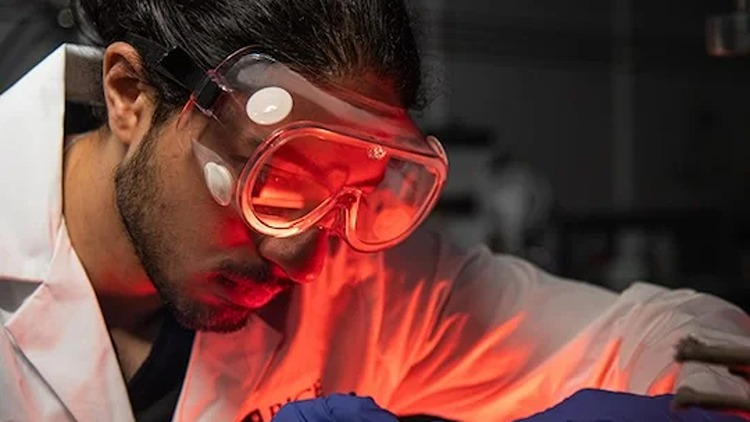
“This is the first demonstration of a transfer-free method to grow 2D devices,” said Sathvik Ajay Iyengar, a doctoral student at Rice and a first author on the study along with Rice doctoral alumnus Lucas Sassi. “This is a solid step toward reducing processing temperatures and making a transfer-free, 2D semiconductor-integration process possible.”
“We received a sample from a collaborator that had gold markers patterned on it,” Sassi said. “During CVD growth, the 2D material unexpectedly formed predominantly on the gold surface. This surprising result sparked the idea that by deliberately patterning metal contacts, we might be able to guide the growth of 2D semiconductors directly across them.”
Semiconductors form the foundation of modern computing. As the industry pushes for smaller components, integrating high-performance, atomically thin materials such as tungsten diselenide has become a priority. But fabrication requires 2D semiconductors at high temperatures and then transferring them, often damaging the fragile films.
“The transfer process can degrade the material and damage its performance,” said Iyengar, who is part of Pulickel Ajayan’s research group at Rice.
“Understanding how these 2D semiconductors interact with metals, especially when grown in situ, is really valuable for future device fabrication and scalability,” said Ajayan, Rice’s Benjamin M. and Mary Greenwood Anderson Professor of Engineering and professor of materials science and nanoengineering.
Advanced imaging confirmed the metal contacts remained intact despite the heat. “A lot of our work in this project was focused on proving that the materials system is still intact,” Iyengar said. “We are well-equipped here at Rice to study the chemistry that goes on in this process to a very fine degree. Seeing what happens at the interface between these materials was a great motivator for the research.”
The success of the method lies in the interaction between the metal and the 2D material during growth, Sassi noted.
“The absence of reliable, transfer-free methods for growing 2D semiconductors has been a major barrier to their integration into practical electronics,” he said. “This work could unlock new opportunities for using atomically thin materials in next-generation transistors, solar cells and other electronic technologies.”
Electrical contact quality remains a hurdle in 2D semiconductor design. “An in-situ growth approach allows us to combine several strategies for achieving improved contact quality simultaneously,” said Anand Puthirath, a co-corresponding author of the study and a former research scientist at Rice.
The idea originated from a U.S.-India research initiative asking whether a low-budget fabrication process for 2D materials was feasible.
“This started through our collaboration with partners in India,” said Iyengar, who is a fellow of the Japan Society for the Promotion of Science and an inaugural recipient of the Quad Fellowship, a program launched by the governments of the U.S., India, Australia and Japan to support early career scientists in exploring how science, policy and diplomacy intersect on the global stage. “It showed how international partnerships can help identify practical constraints and inspire new approaches that work across global research environments.”
Iyengar, a Japan Society for the Promotion of Science fellow and an inaugural recipient of the Quad Fellowship – a program launched by the U.S., India, Australia, and Japan – said the project highlights how science and policy intersect. Alongside peers in the program, he co-authored an article advocating for “the need for expertise at the intersection of STEM and diplomacy.”
“Greater engagement between scientists and policymakers is critical to ensure that scientific advancements translate into actionable policies that benefit society as a whole,” Iyengar said. “Materials science is one of the areas of research where international collaboration could prove invaluable, especially given constraints such as the limited supply of critical minerals and supply chain disruptions.”
The research was supported by the U.S. Air Force Research Laboratories, UES, the National Science Foundation (1626418), the Brazilian Ministry of Education, the U.S. Department of Energy (DE-SC0012547), the Army Research Office (W911NF-16-1-0255) and the Shared Equipment Authority at Rice.
Source: Rice University
About Rice University

Rice University, founded in 1912 and based in Houston, TX, is a private research institution ranked among the nation’s top 20 universities by U.S. News & World Report. The university operates eight schools covering engineering, business, architecture, music, humanities, social sciences, natural sciences, and continuing studies. It is home to research centers including the Baker Institute for Public Policy and the Kinder Institute for Urban Research, along with international centers in Paris and Bengaluru, India. With 4500+ undergraduates, 4000+ graduate students, and a 6-to-1 undergraduate student-to-faculty ratio, Rice emphasizes academic rigor and close-knit residential communities. Its $8 billion endowment funds, about 40% of its operating budget, and annual revenue is estimated at roughly $750M. The university serves fields ranging from energy policy and materials science to entrepreneurship and the arts, combining research excellence with a global perspective.
