

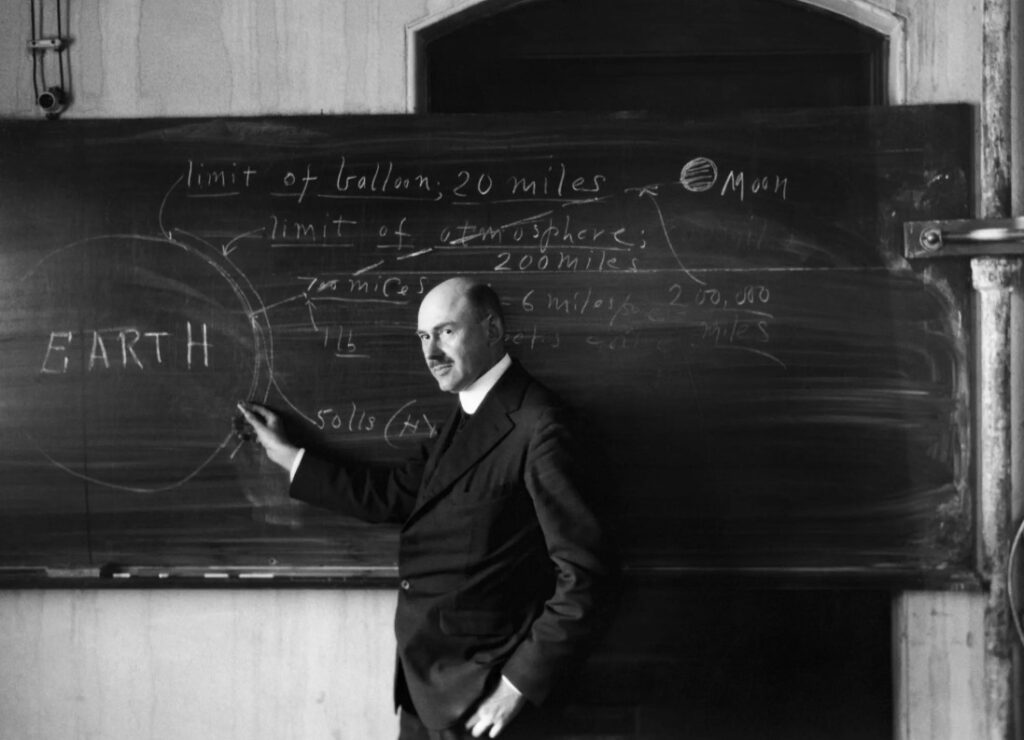
On March 16, 1926, physicist Robert H. Goddard carried out an experiment that would quietly transform the future of space travel. On his aunt’s farm in Auburn, Massachusetts, Goddard launched the world’s first liquid-fueled rocket, a crude but revolutionary vehicle that demonstrated a new approach to propulsion. Though the event attracted little attention at the time, it marked a turning point in the development of rockets capable of carrying satellites, probes, and eventually humans beyond Earth’s atmosphere, tells The New York Times.
Goddard, born in Worcester, Massachusetts, in 1882, developed an early fascination with science and science fiction. Inspired by writers such as H.G. Wells and Jules Verne, he imagined spacecraft traveling to Mars while still a teenager. As a physics professor at Clark University, he pursued these ambitions through experiments in rocketry, convinced that liquid fuels offered the power and control required for space travel.
Earlier rockets relied on solid propellants, which burn uncontrollably once ignited. Goddard believed liquid propellants could provide greater thrust and allow engineers to regulate fuel flow during flight. His experimental rocket, nicknamed Nell, used gasoline and liquid oxygen. The vehicle stood roughly 10 feet tall and was assembled with the help of his wife, Esther, and two assistants beside a cabbage patch on the farm.
The launch itself was simple and improvised. An assistant ignited the rocket using a blowtorch, and Goddard opened the fuel valves to begin combustion. At about 2:30 p.m., the rocket lifted off, rising approximately 41 feet before tilting sideways and landing 184 feet away after a flight lasting about 2.5 seconds.
Despite its brief flight, the experiment proved that liquid-fuel rockets could work. Goddard continued refining his designs, eventually conducting dozens of launches and securing more than 200 patents. Although he received little recognition during his lifetime, his innovations became fundamental to modern rocket engineering.
Today’s launch vehicles, from satellite carriers to human spaceflight systems, still rely on principles pioneered by Goddard nearly a century ago.
