

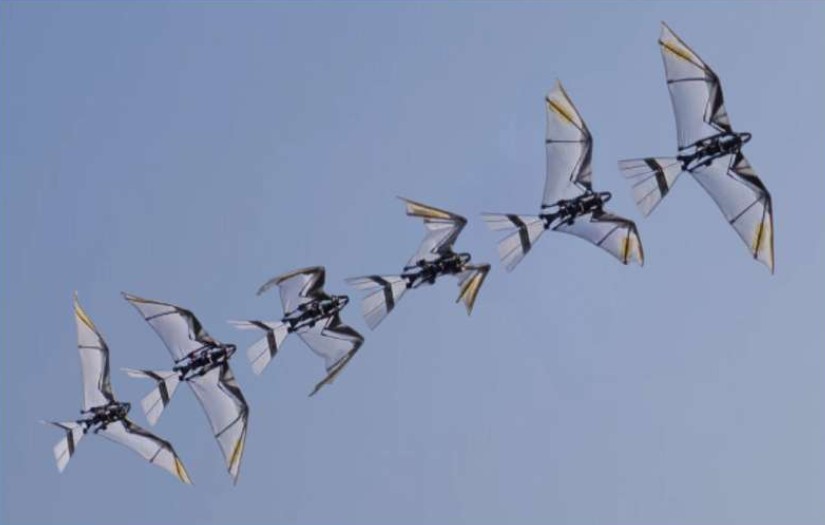
Researchers in China have developed RoboFalcon 2.0, an updated flapping-wing robot that can achieve unassisted takeoff and sustain flight even at lower speeds, thanks to a more complex wing mechanism, tells Tech Xplore. Previous versions of RoboFalcon needed external help to lift off and didn’t perform well at slow speeds; this new design overcomes those limitations.
The key advance is a wing system that combines three types of motion, i.e., flapping, sweeping, and folding (FSF)—all within a single wingbeat. This trio of motions more closely mimics how large flying vertebrates such as birds and bats move their wings, especially during takeoff or maneuvering slowly. The robot weighs about 800 grams and uses reconfigurable mechanical components (“decouplers”) that allow the wing to change shape and angle in flight for lift, thrust, pitch, and roll control.
Researchers tested this design in wind tunnels, simulations, and outdoor flights. Wind-tunnel and simulation data showed that increasing wing sweep contributes significantly to lift and helps with controlling pitch. Actual flight tests confirmed that RoboFalcon 2.0 can take off on its own using ventral anterior flapping downstrokes and tucked upstrokes, and that wing sweeping and folding help stabilize its flight.
While RoboFalcon 2.0 marks a leap forward for bio-inspired robotics, it still has shortcomings. The robot lacks yaw control, especially in real-world hover conditions, and energy efficiency during takeoff remains poorer than that for birds or insect-scale flying robots. Also, the team notes it would benefit from a tail elevator to improve stability in faster flight.
RoboFalcon 2.0 demonstrates that adding FSF wing motion lets robotic flyers behave more like natural fliers—able to launch themselves and fly slowly without external support. It narrows the gap between engineered and biological flight, though work remains to refine efficiency, control, and stability.
